Differentiation · Library · Visual references

Visual references

The framework's structural recognitions, rendered.

Diagrams and infographics that carry the framework's structural recognitions visually. Each visual is recognition infrastructure inherently — looking at it produces the same structural understanding the textual canonical references carry. Each passes the five-second test.

Visual register: dark field, luminous gold geometry, sans-serif labels, minimal text. The form does the work; labels point at it rather than carrying it.

Click any visual for the full SVG. Right-click any PNG to save.
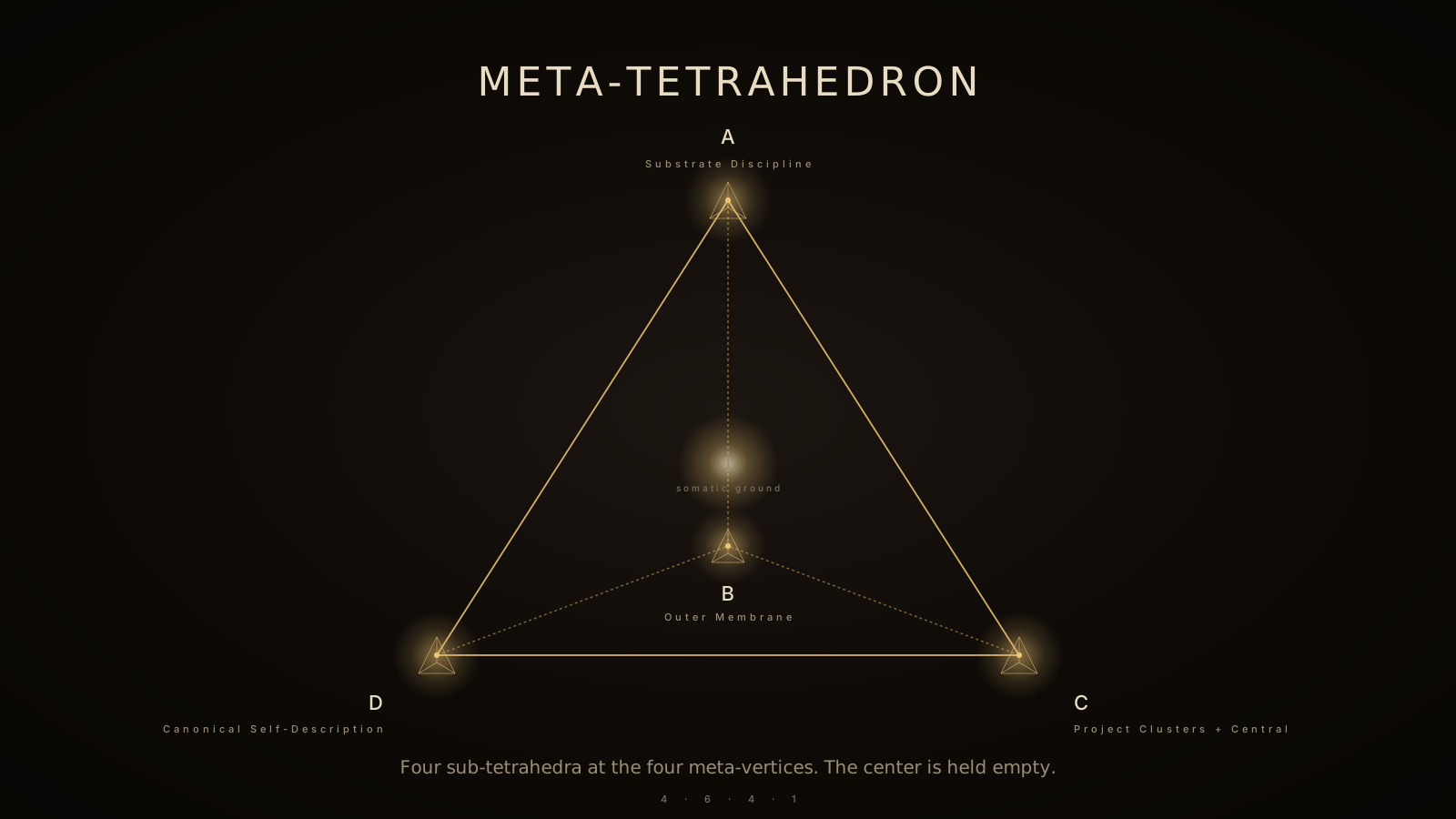
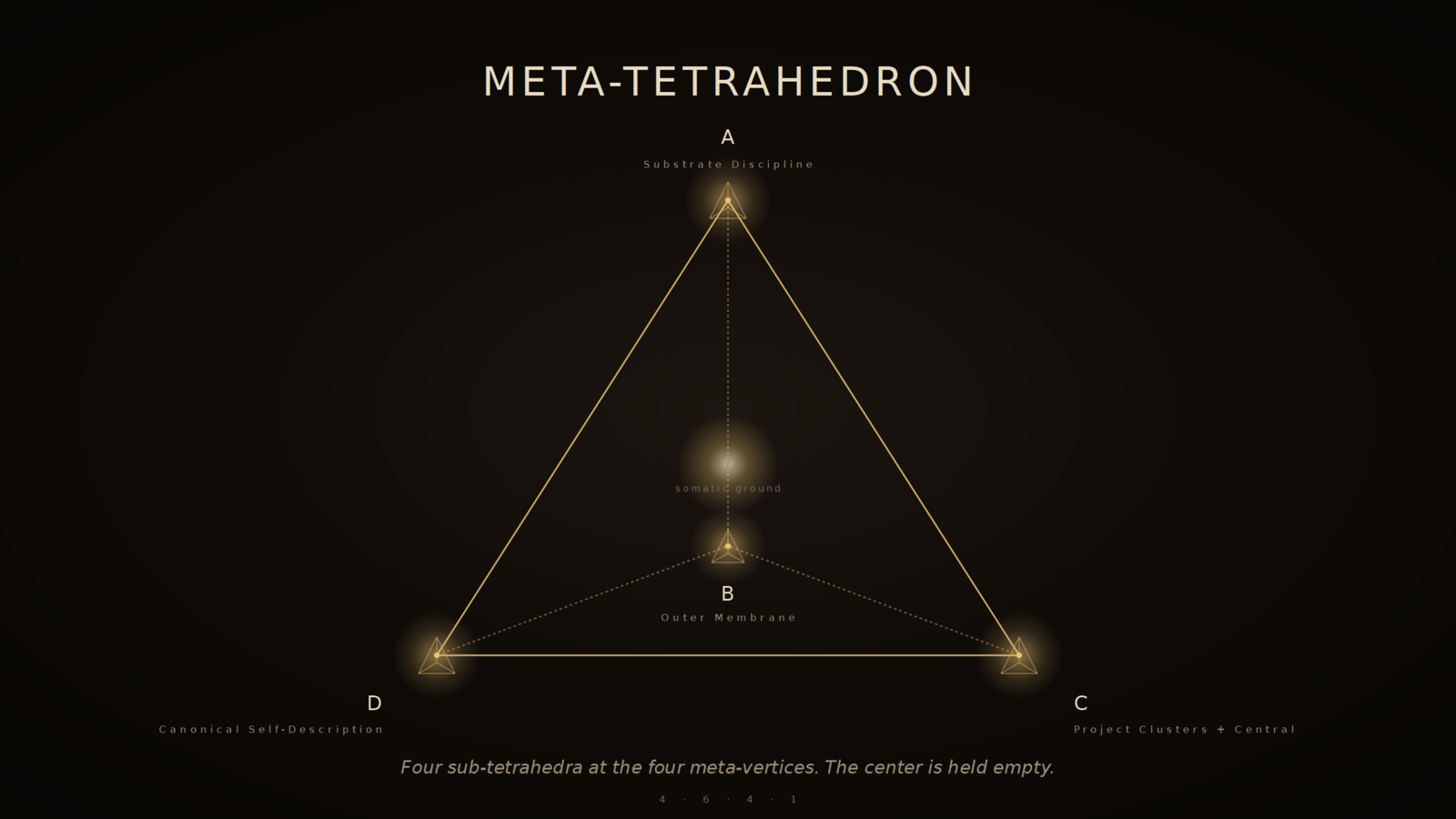
Meta-Tetrahedron · four sub-tetrahedra at the four meta-vertices
1 · the master form
Four sub-tetrahedra at the four meta-vertices of a single meta-form. The center is held empty. Each meta-vertex is itself a tetrahedron at its own scale — the form recurs.
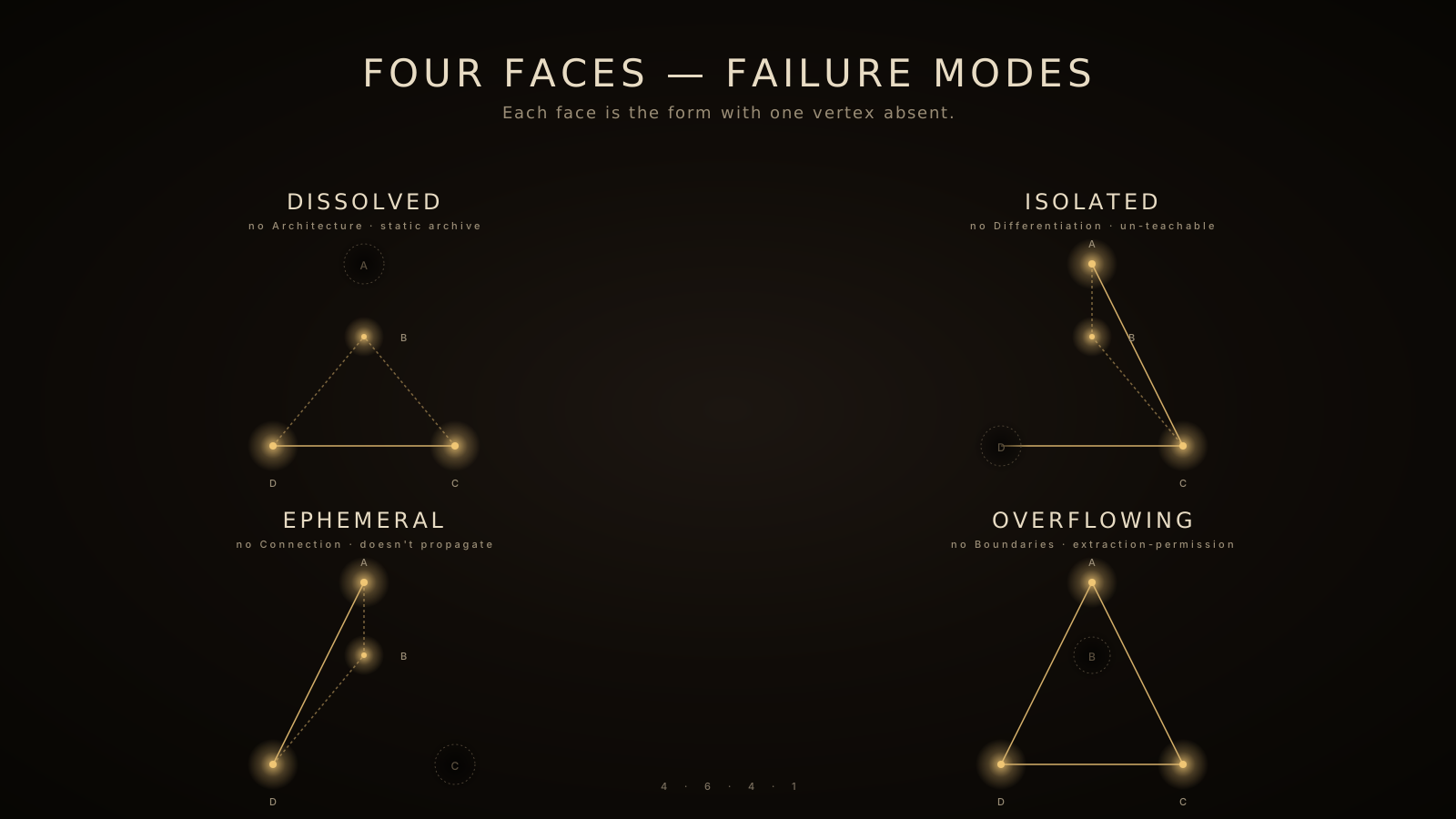
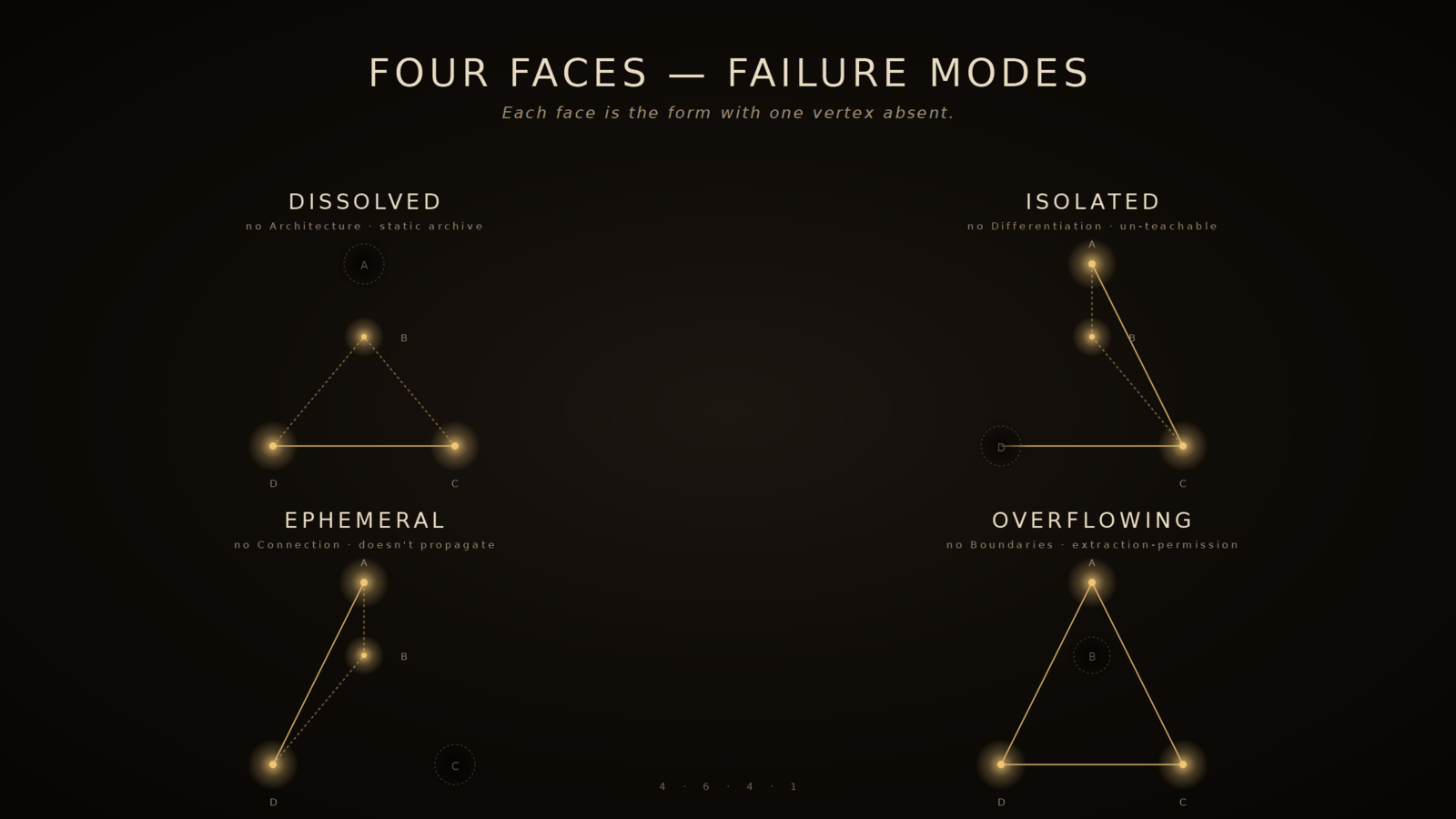
Four Faces — failure modes when one vertex is absent
2 · failure modes
Each face of the meta-tetrahedron is the form with one vertex absent. Dissolved · Isolated · Ephemeral · Overflowing. Diagnose which face your substrate has collapsed onto.
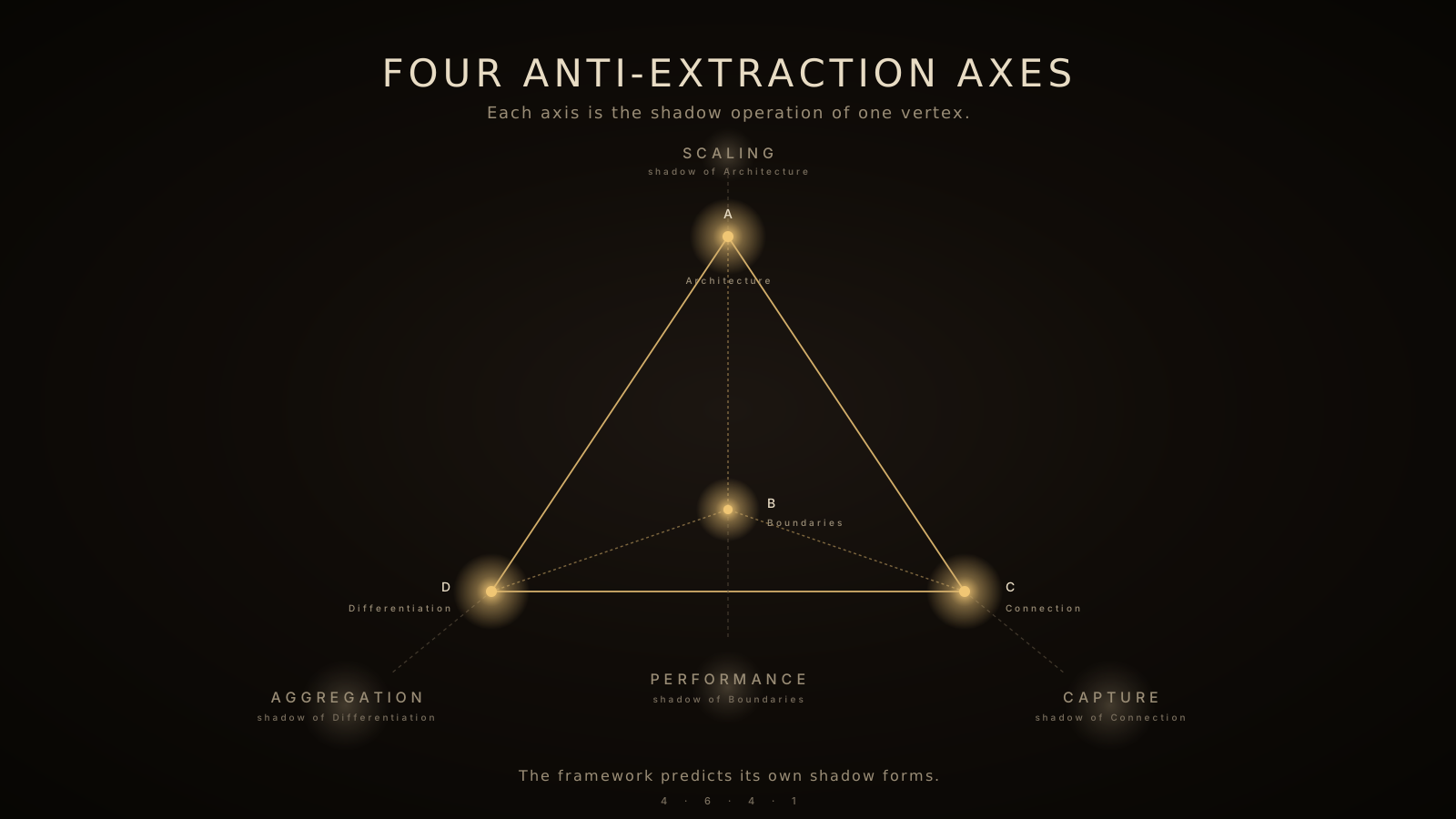
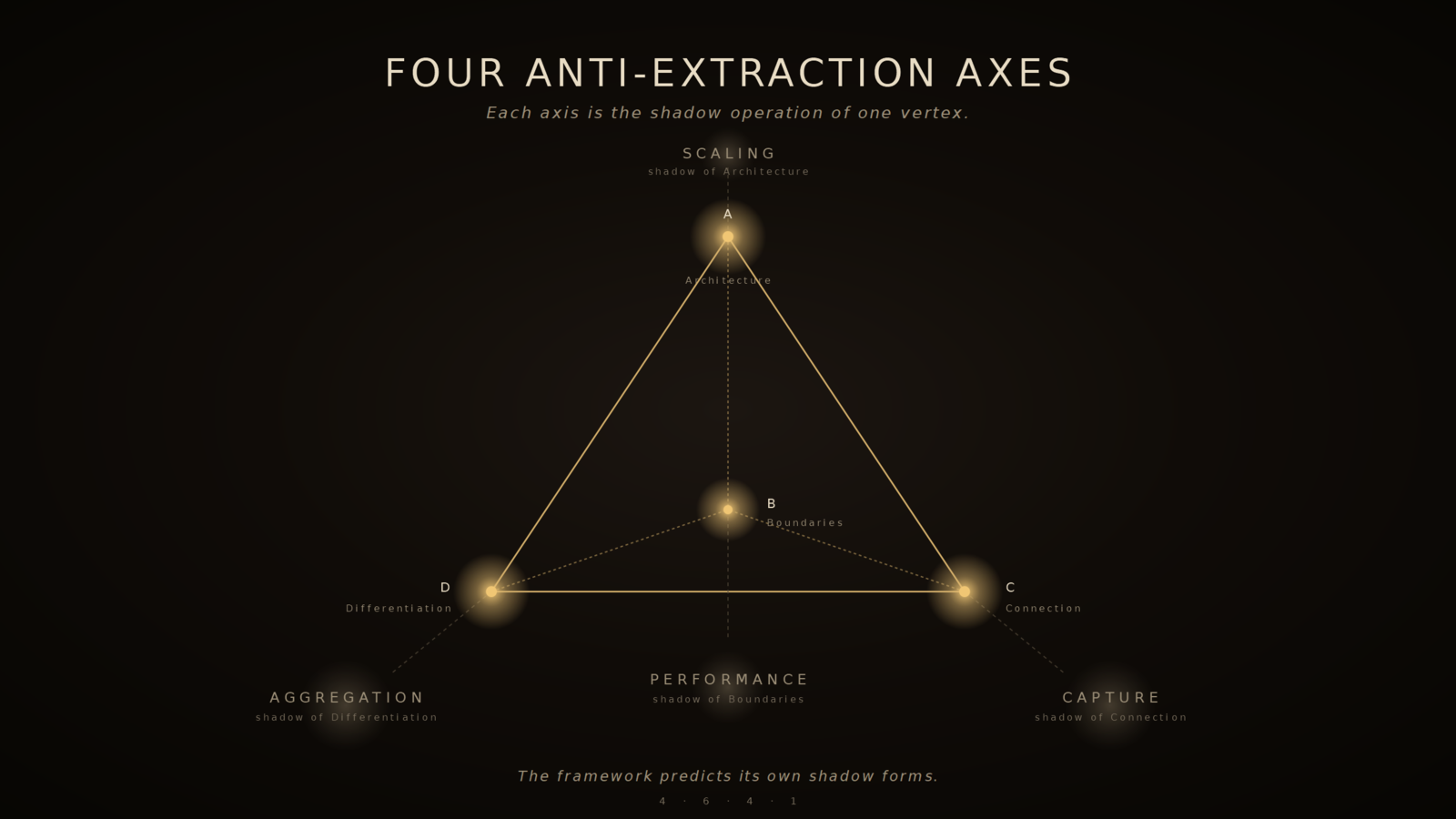
Four Anti-Extraction Axes — vertex shadows
3 · vertex shadows
Each anti-extraction axis is the shadow operation of one primary vertex. Capture · Aggregation · Scaling · Performance. The framework's own refusal structure.
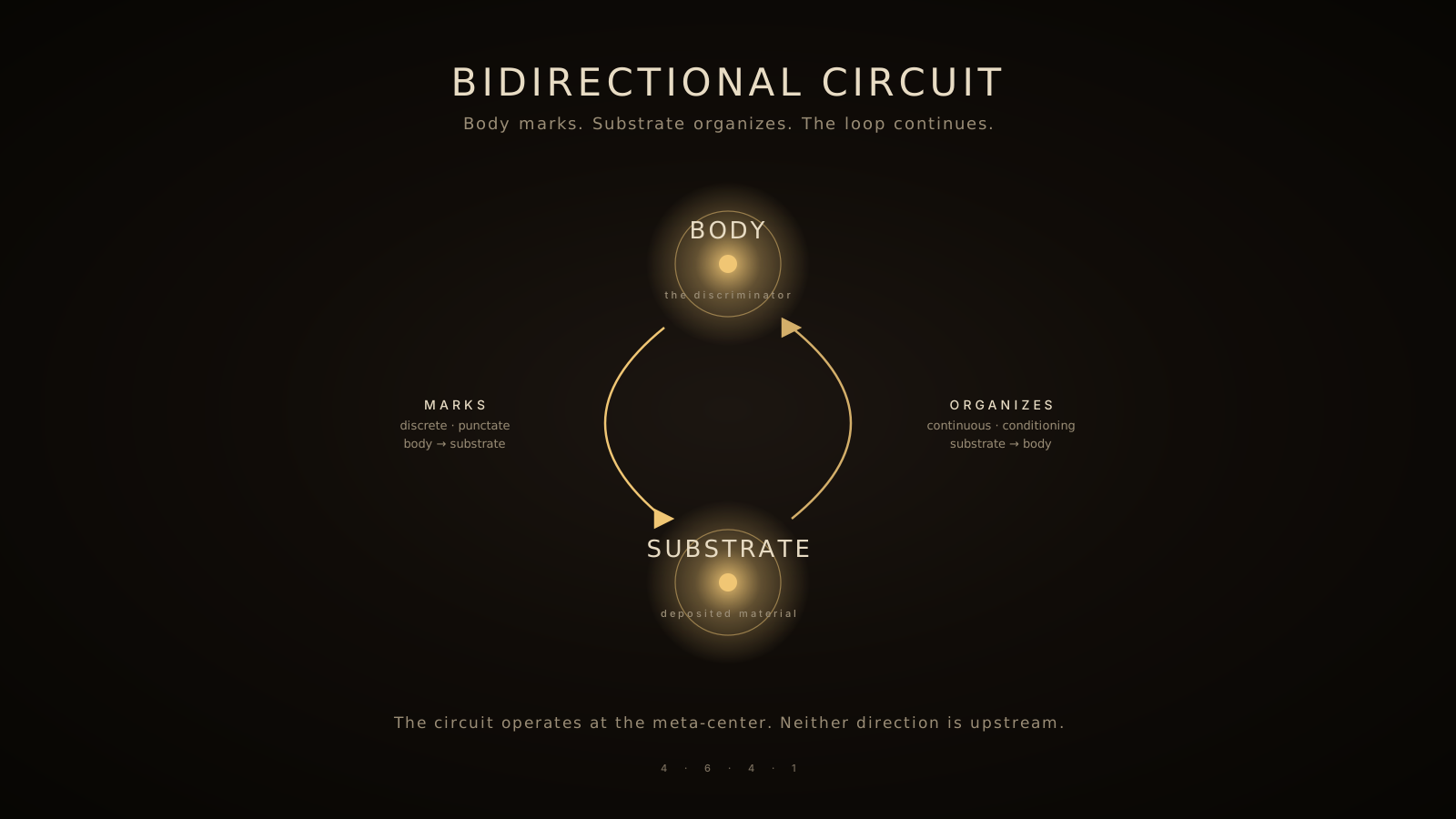
Bidirectional Circuit — body ↔ substrate
4 · body ↔ substrate
The two directions of operation forming a closed circuit at the meta-center. Body marks substrate (discrete punctate deposits); substrate organizes body (continuous conditioning). Neither direction upstream of the other.
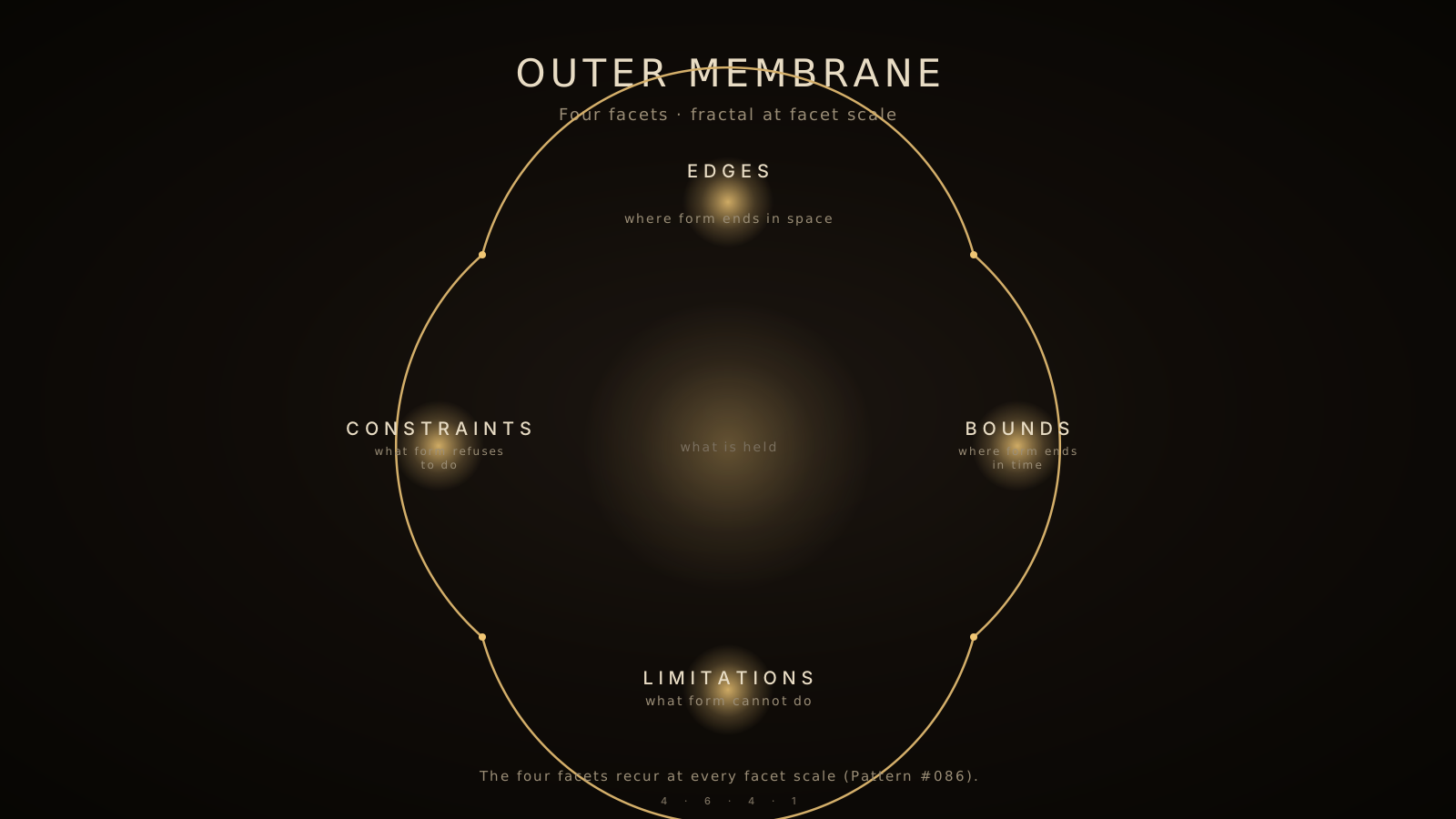
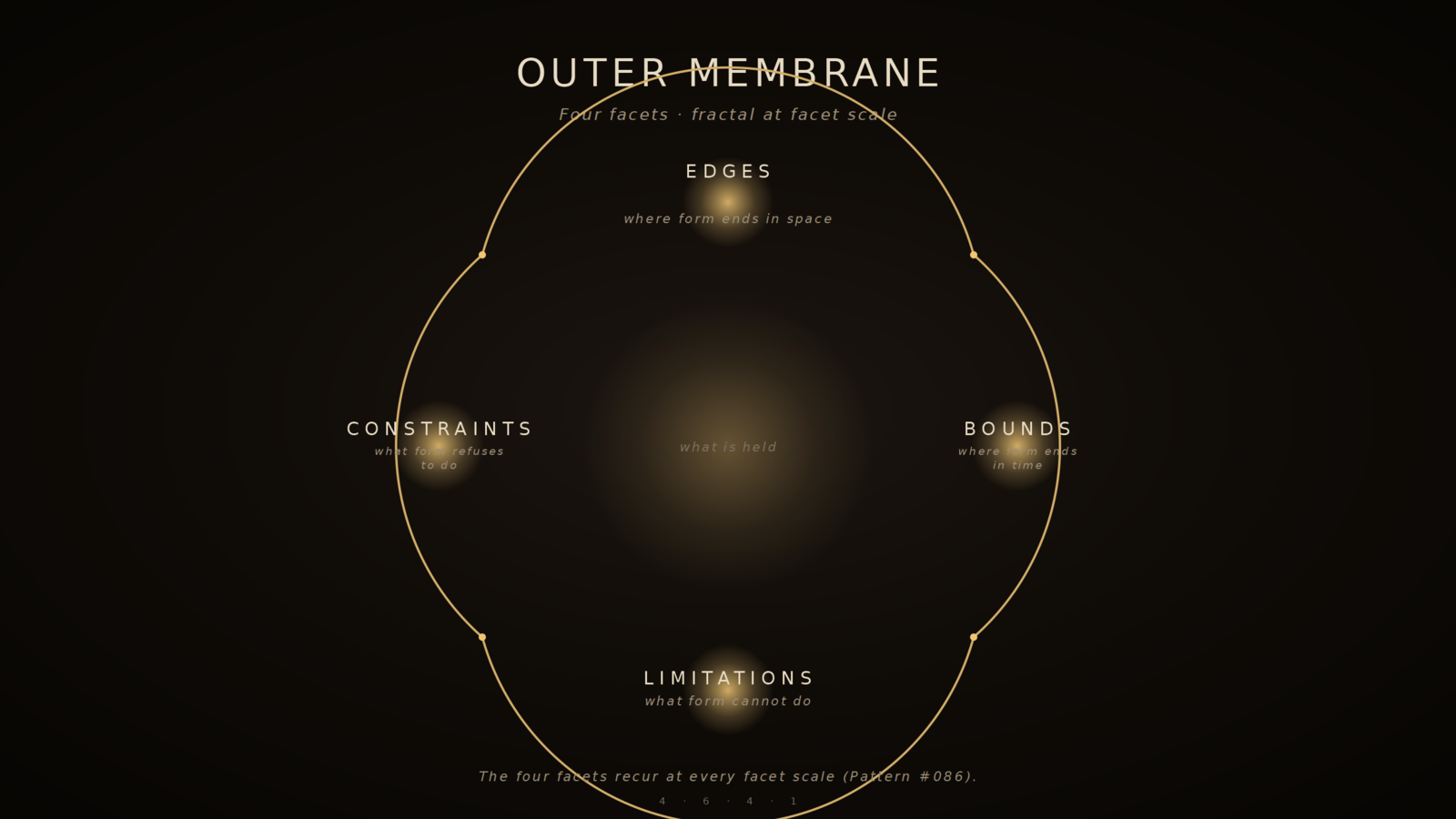
Outer Membrane — four facets
5 · four facets
The four facets of the Membrane that hold a form's edge — Edges (where form ends in space) · Bounds (where form ends in time) · Limitations (what form cannot do) · Constraints (what form refuses to do).
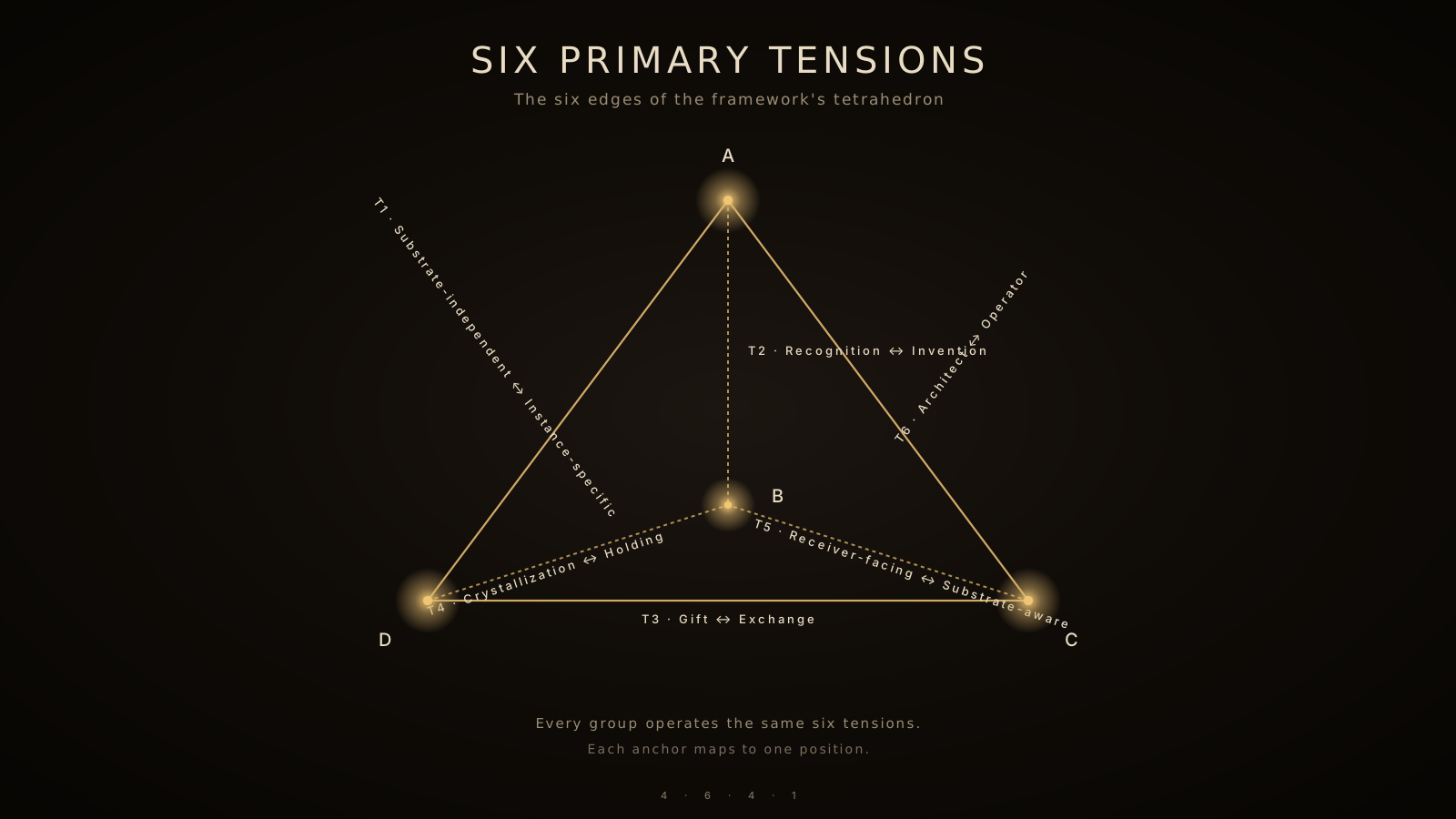
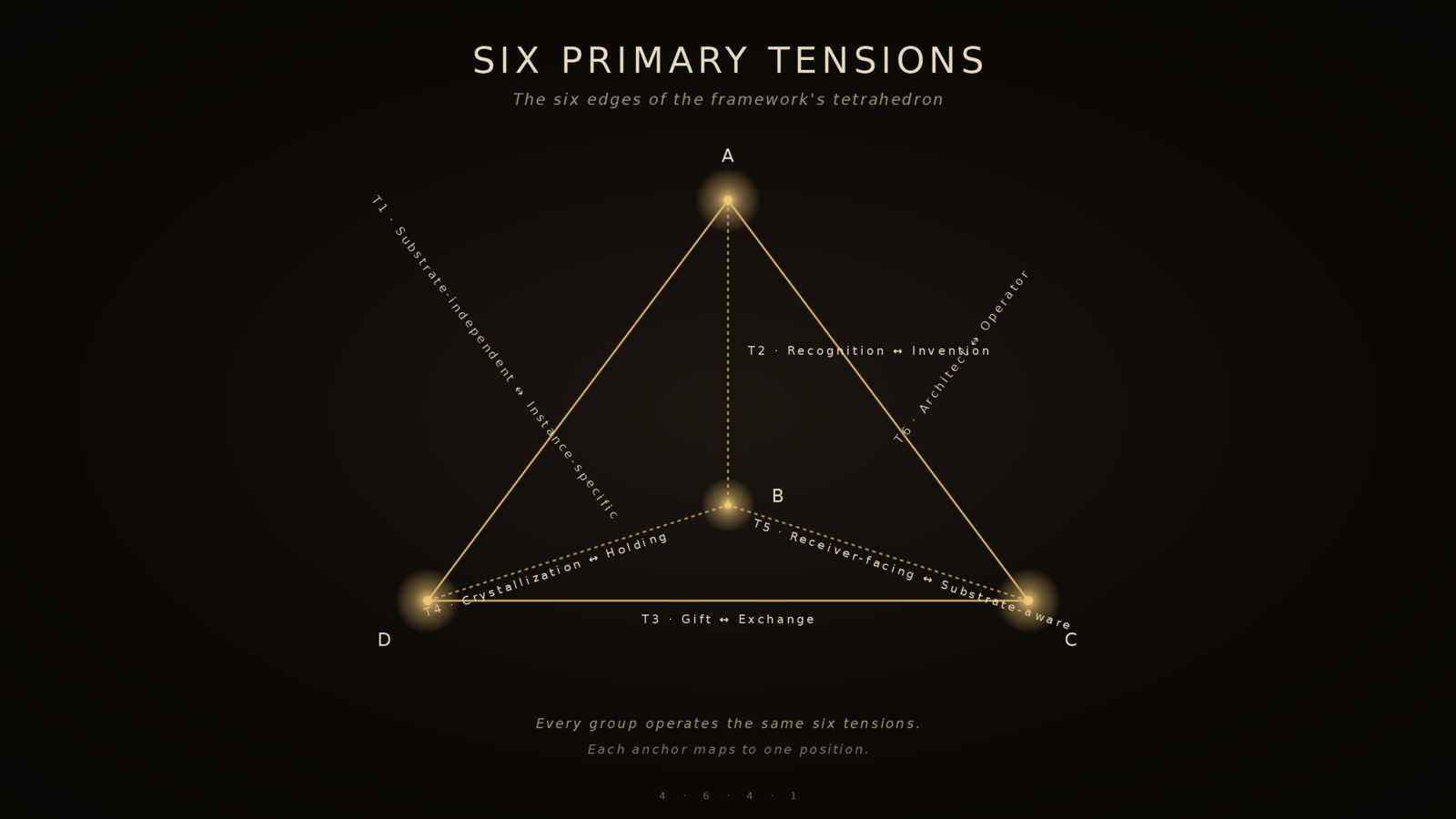
Six Primary Tensions — the six edges
6 · six edges
The six edges of the framework's tetrahedron, each carrying one primary tension. Substrate-independent ↔ Instance-specific · Recognition ↔ Invention · Gift ↔ Exchange · Crystallization ↔ Holding · Receiver-facing ↔ Substrate-aware · Architect ↔ Operator.
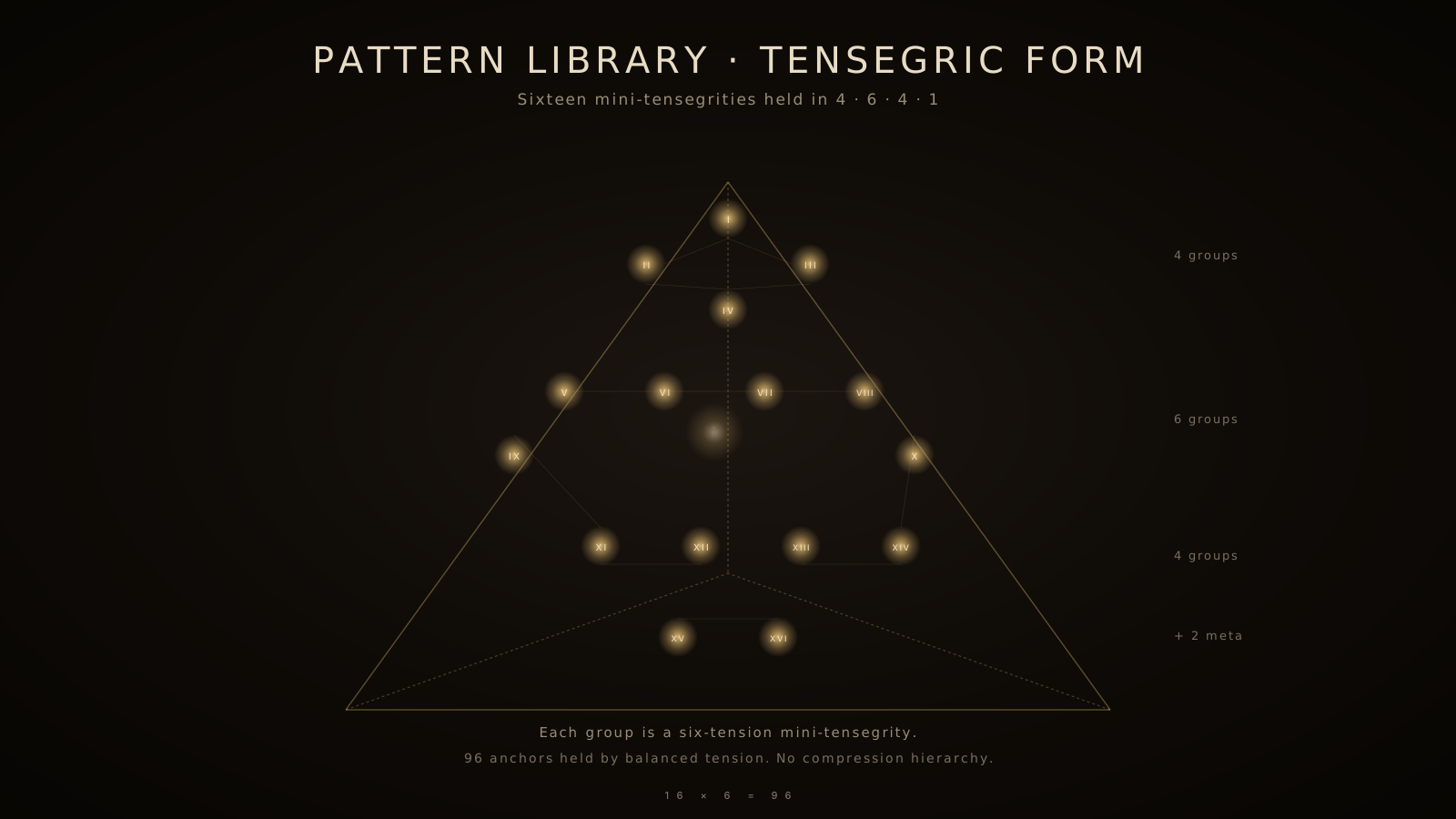
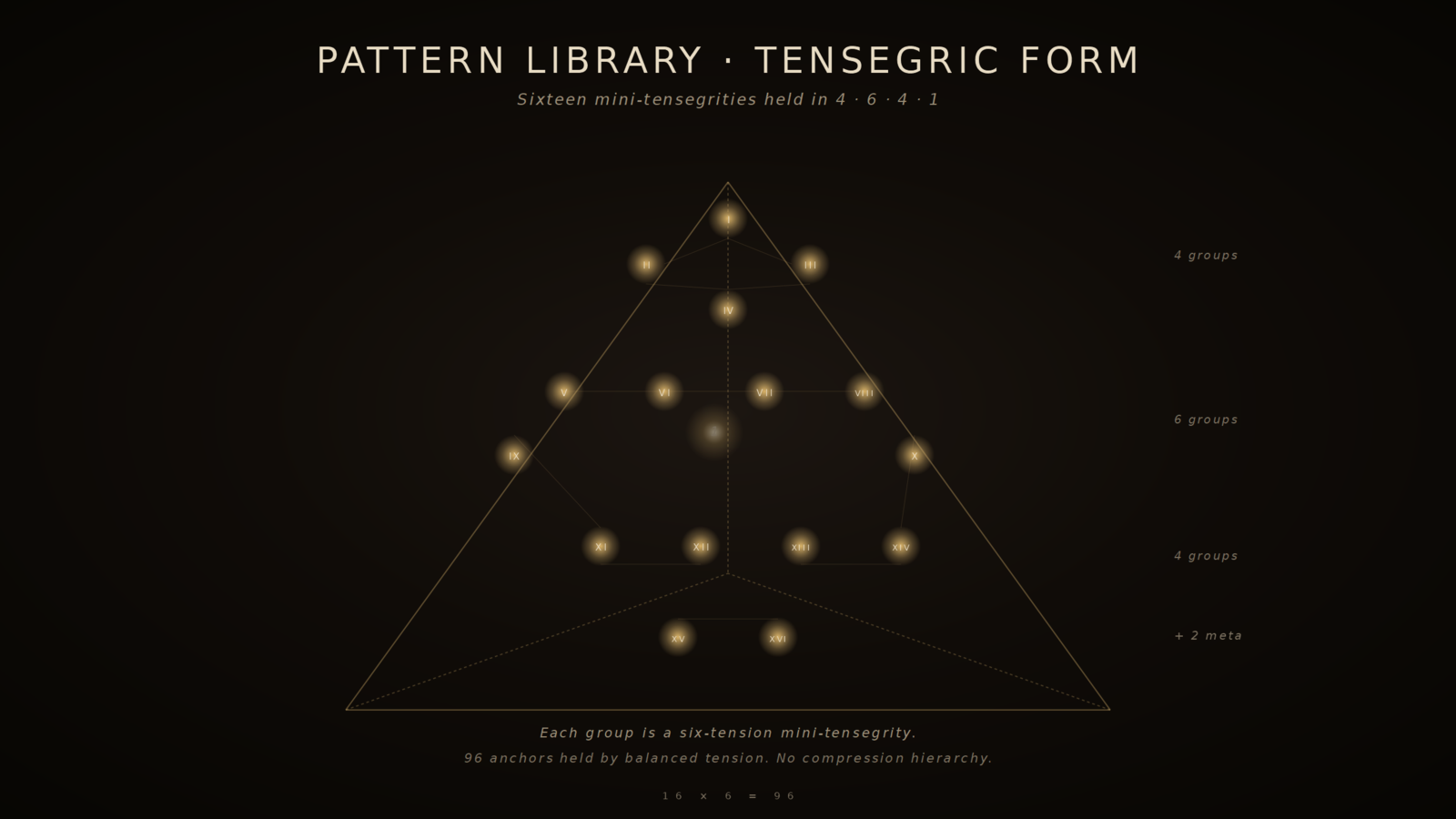
Pattern Library — tensegric form
7 · tensegric form
Sixteen mini-tensegrities (one per group) held in the larger 4·6·4·1 form. The library is not compression hierarchy; it is tensegrity — balanced tension across anchors holding the whole.
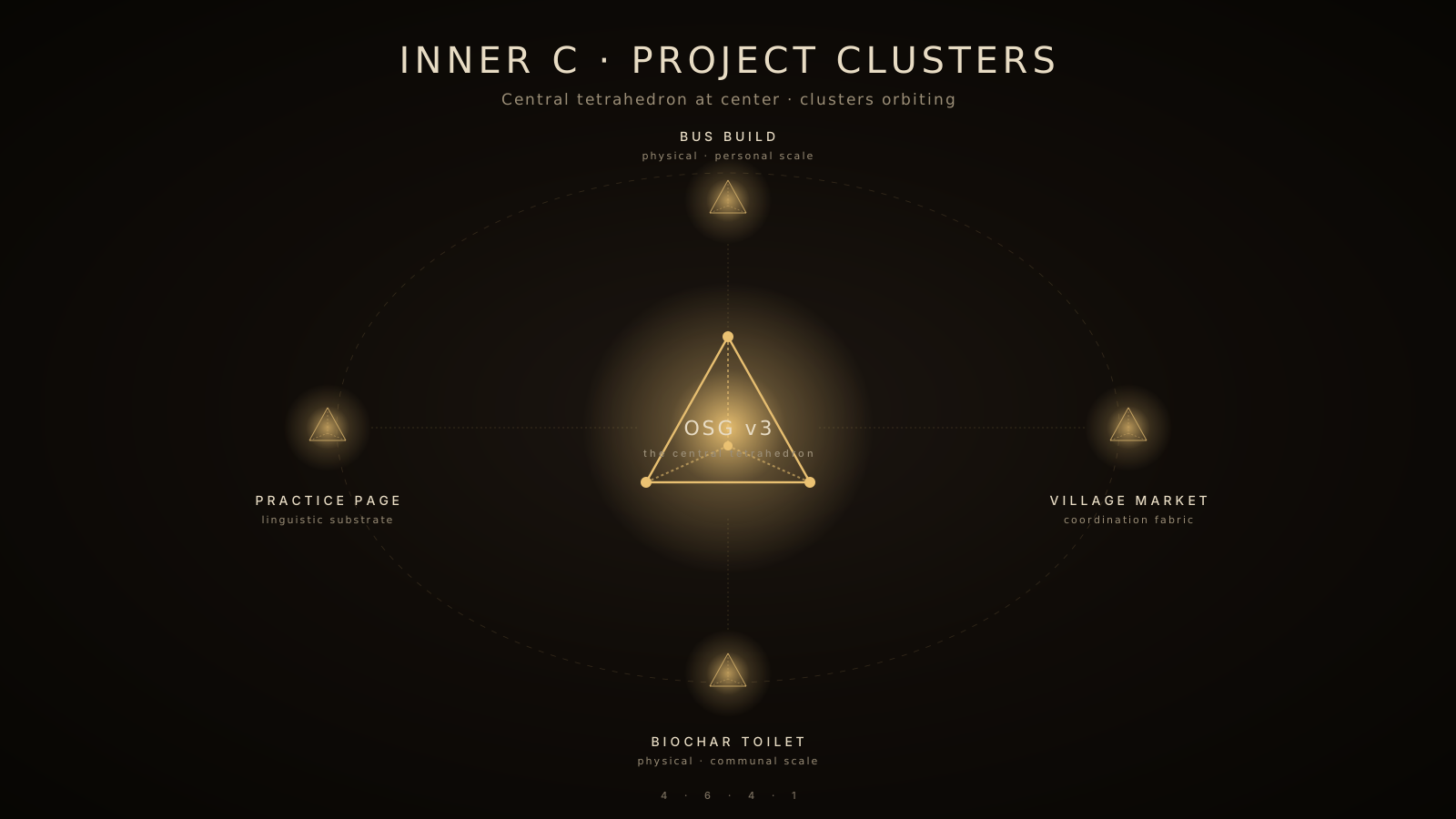
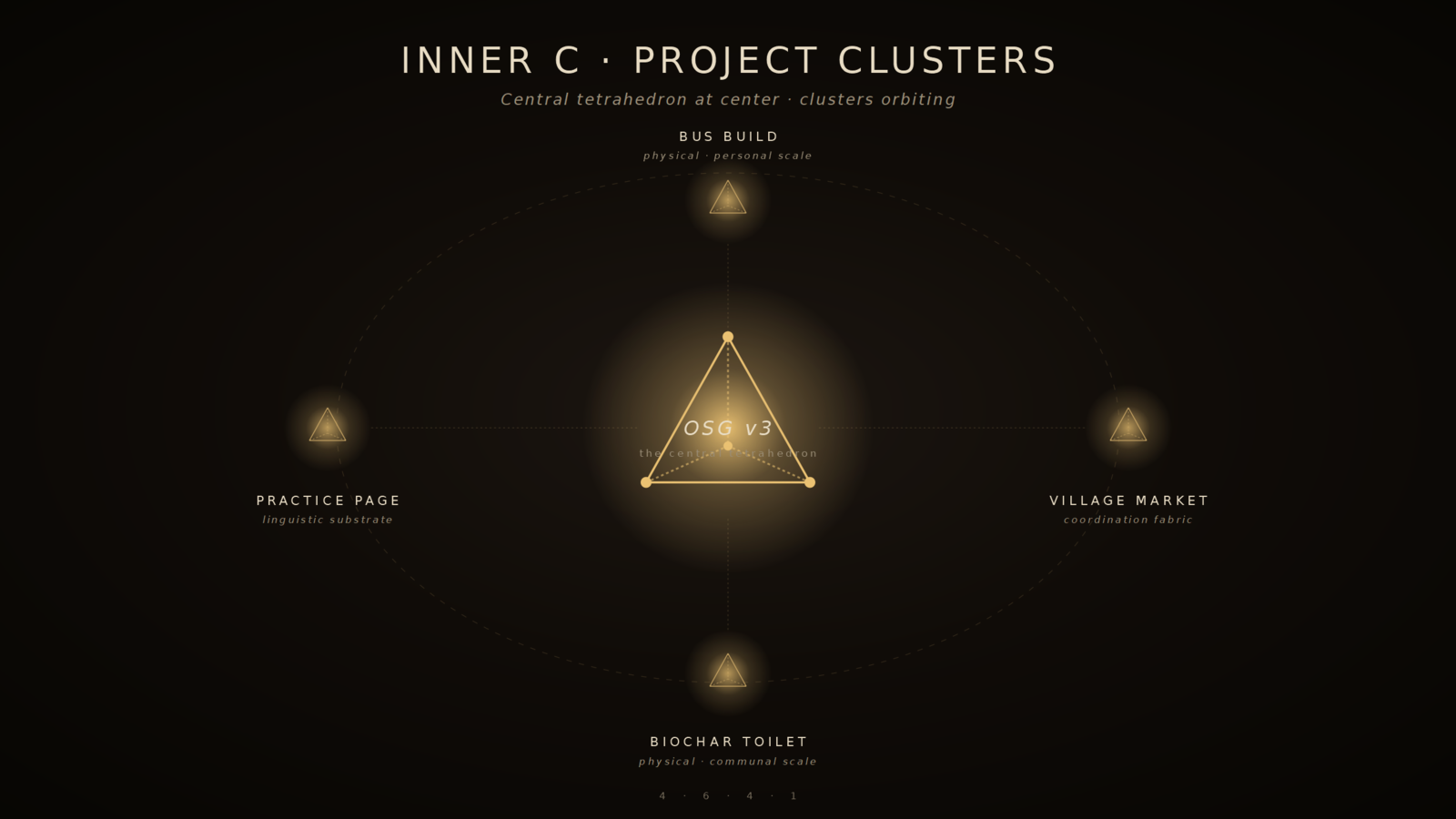
Inner C — project clusters
8 · project clusters
The receiver-facing surface at the center with project clusters orbiting — Bus Build · Village Market · Biochar Toilet · Practice Page. Each cluster is itself a tetrahedron at its own scale.
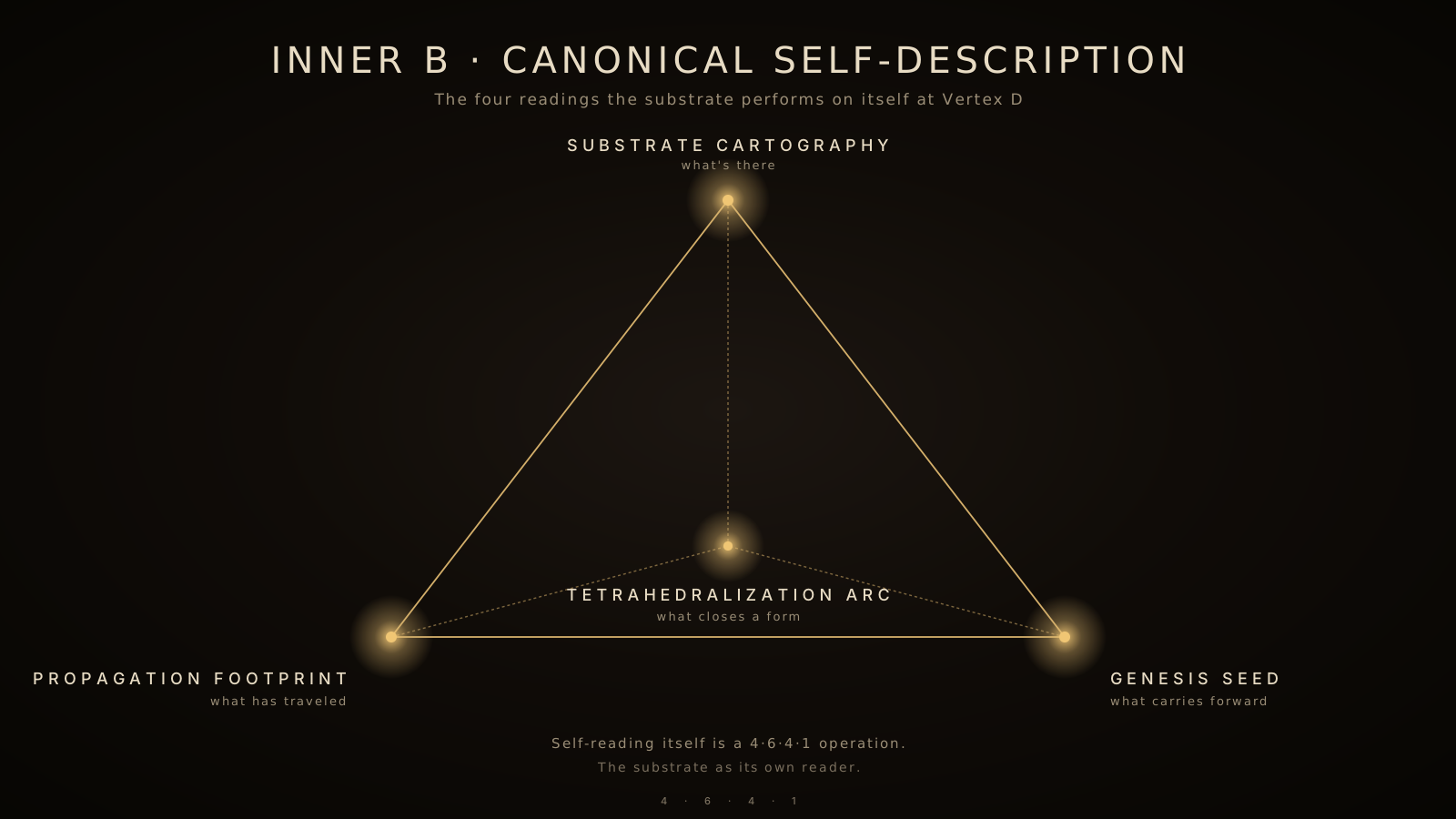
Inner B — canonical self-description
9 · canonical self-description
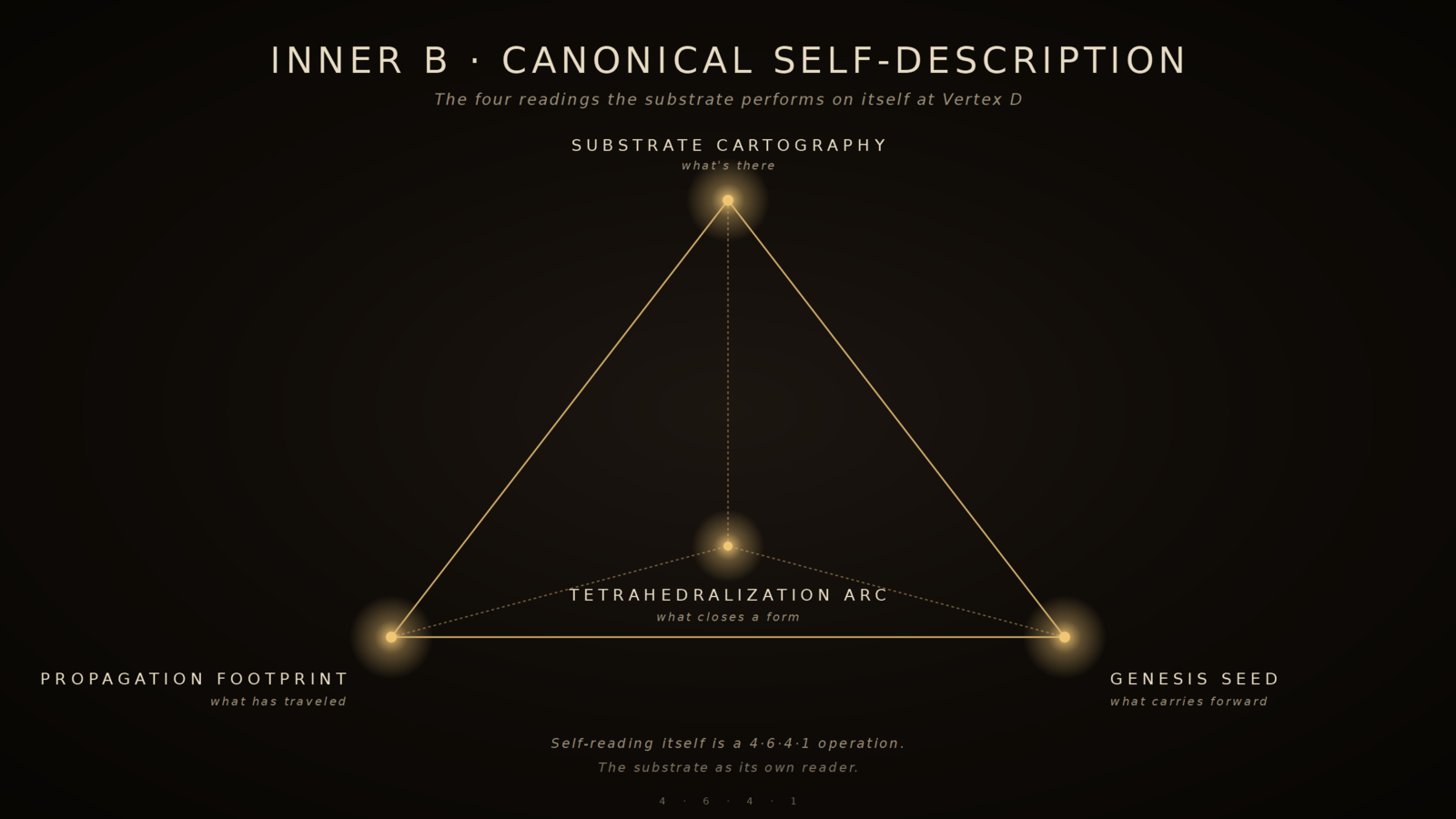
The four readings the substrate performs on itself at Vertex D — Substrate Cartography (what's there) · Propagation Footprint (what has traveled) · Tetrahedralization Arc (what closes a form) · Genesis Seed Canonical Synthesis (what carries forward).
Three-zone economy — Gift · Exchange · Refusal
10 · economic architecture
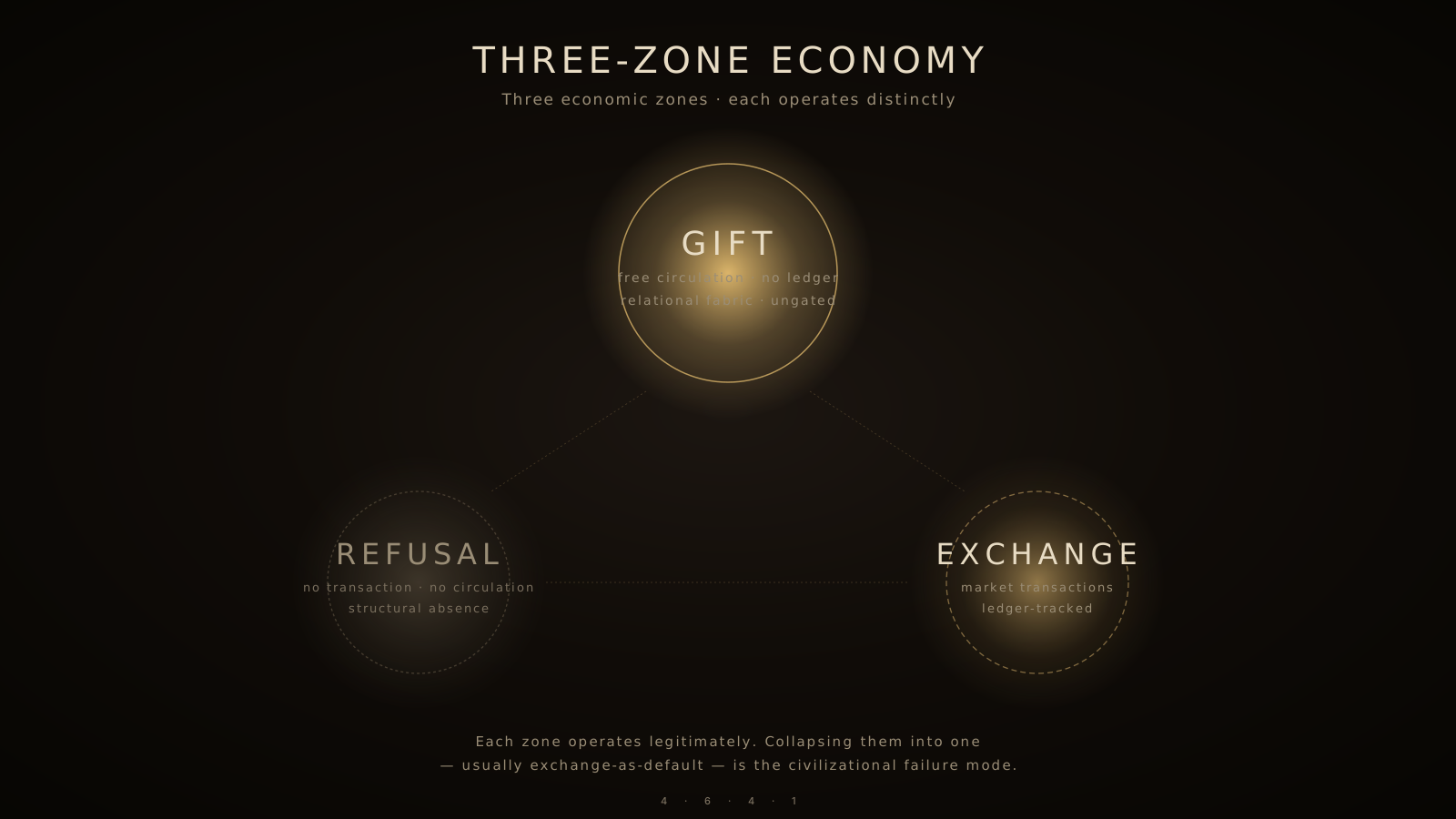
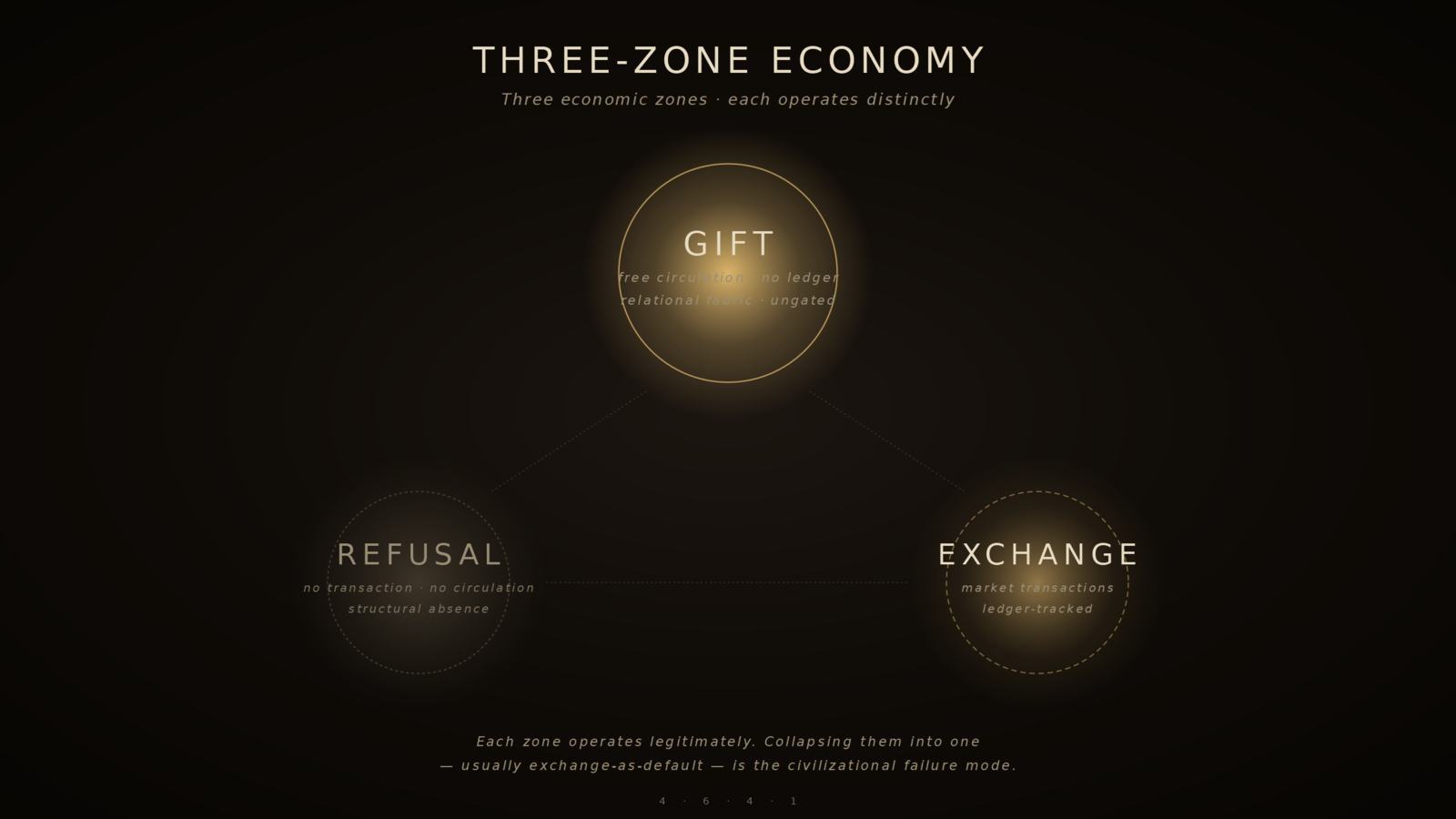
Three distinct economic zones at civilizational scale — Gift (free circulation, no ledger) · Exchange (market transactions, ledger-tracked) · Refusal (no transaction, no circulation; structural absence). Each zone has legitimate operations. Collapsing them is civilizational failure.
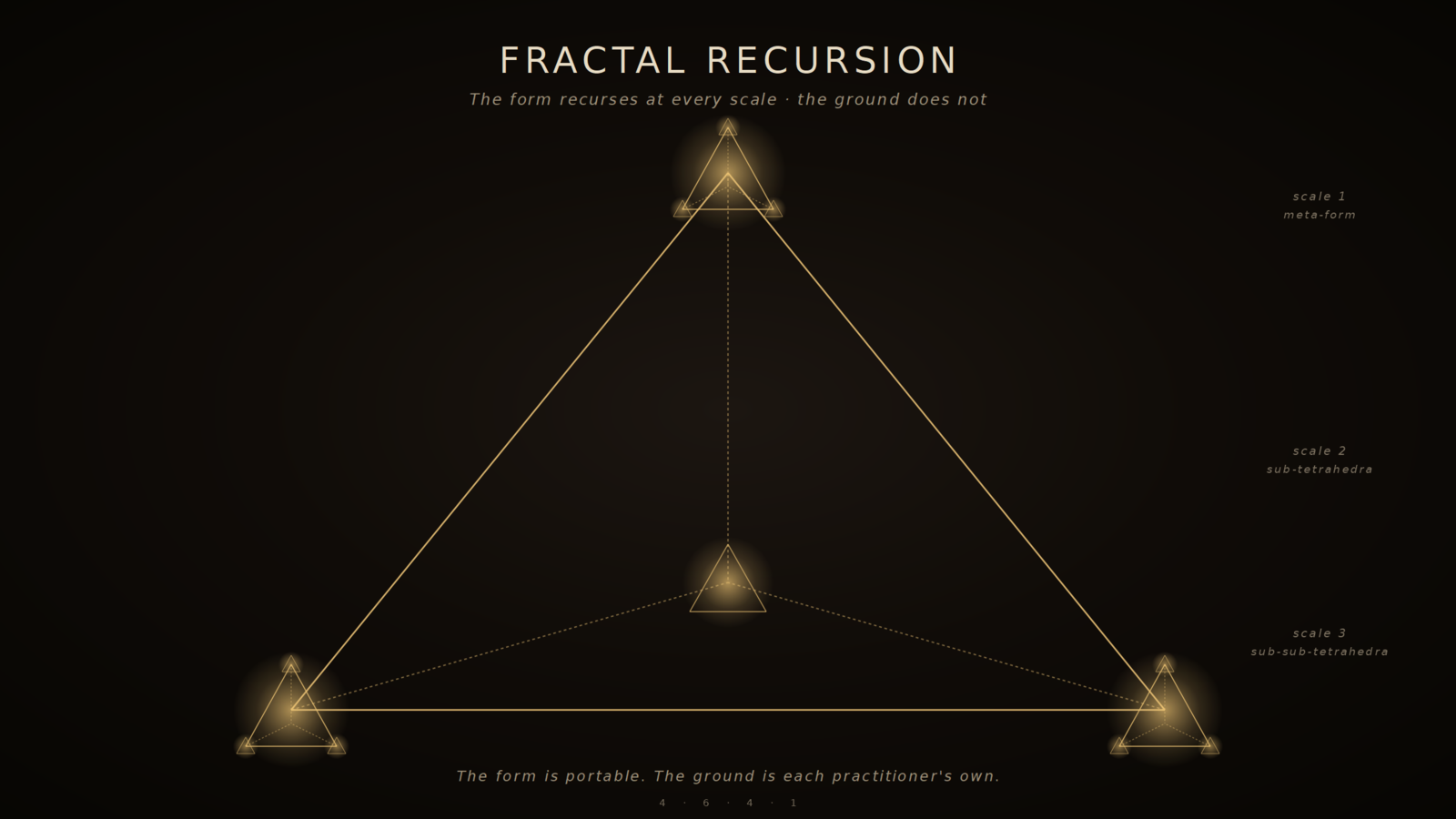
Fractal recursion — three nested scales
11 · scale invariance
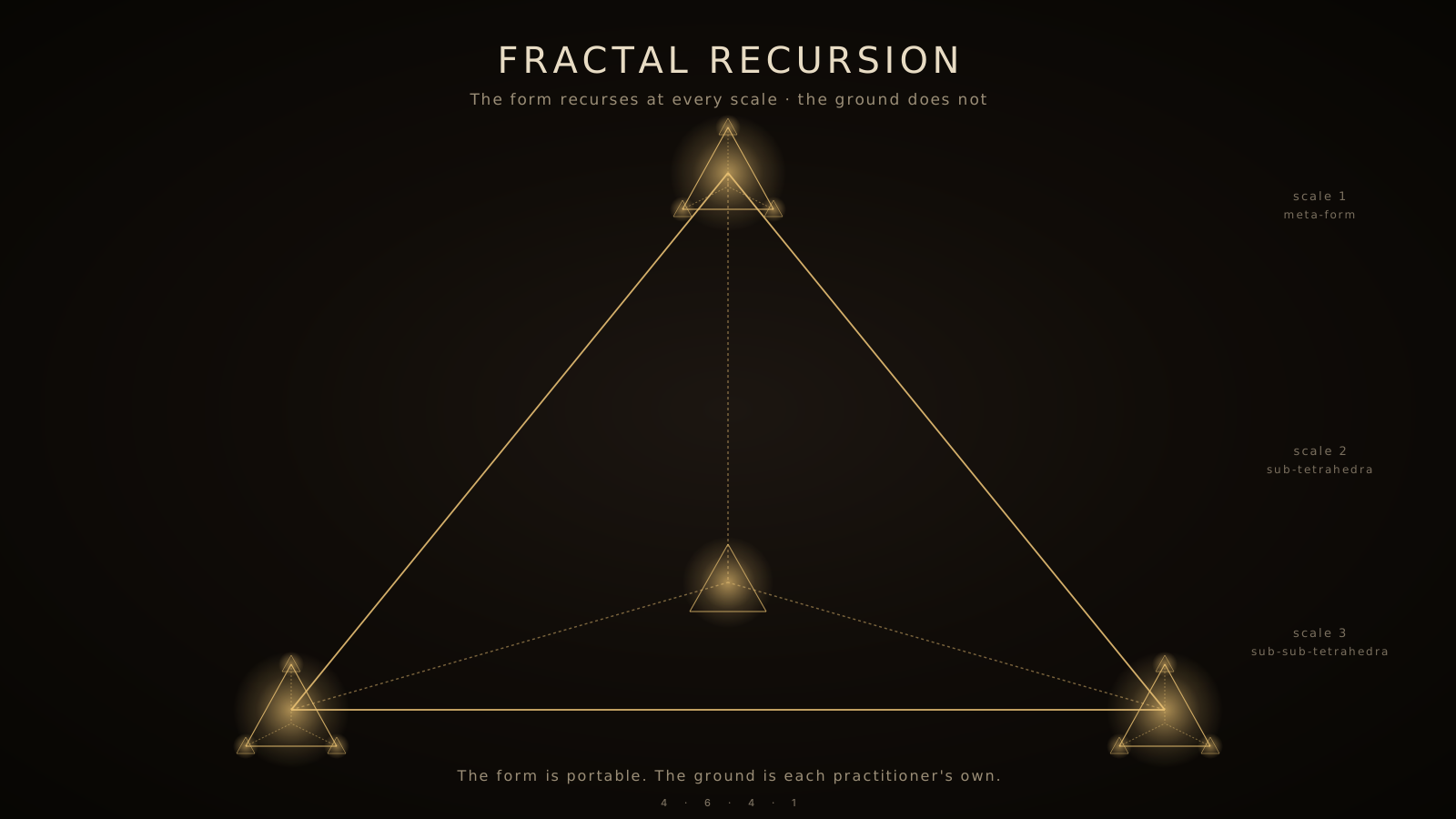
The 4·6·4·1 form recurring at multiple nested scales in one image. Scale 1: the meta-tetrahedron. Scale 2: smaller tetrahedra at each meta-vertex. Scale 3: tiny tetrahedra at the sub-vertices. The form is portable; the ground does not recurse.
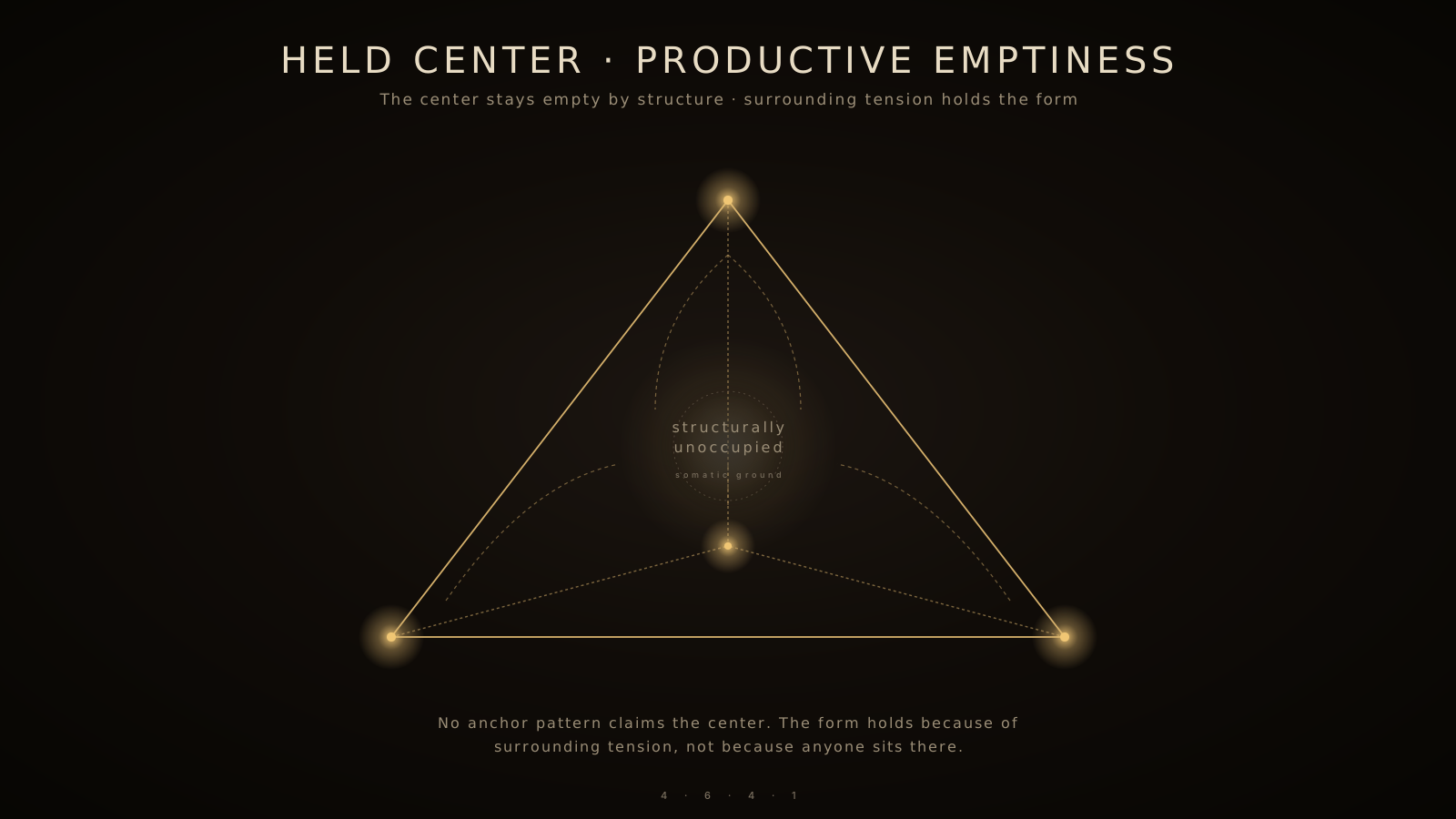
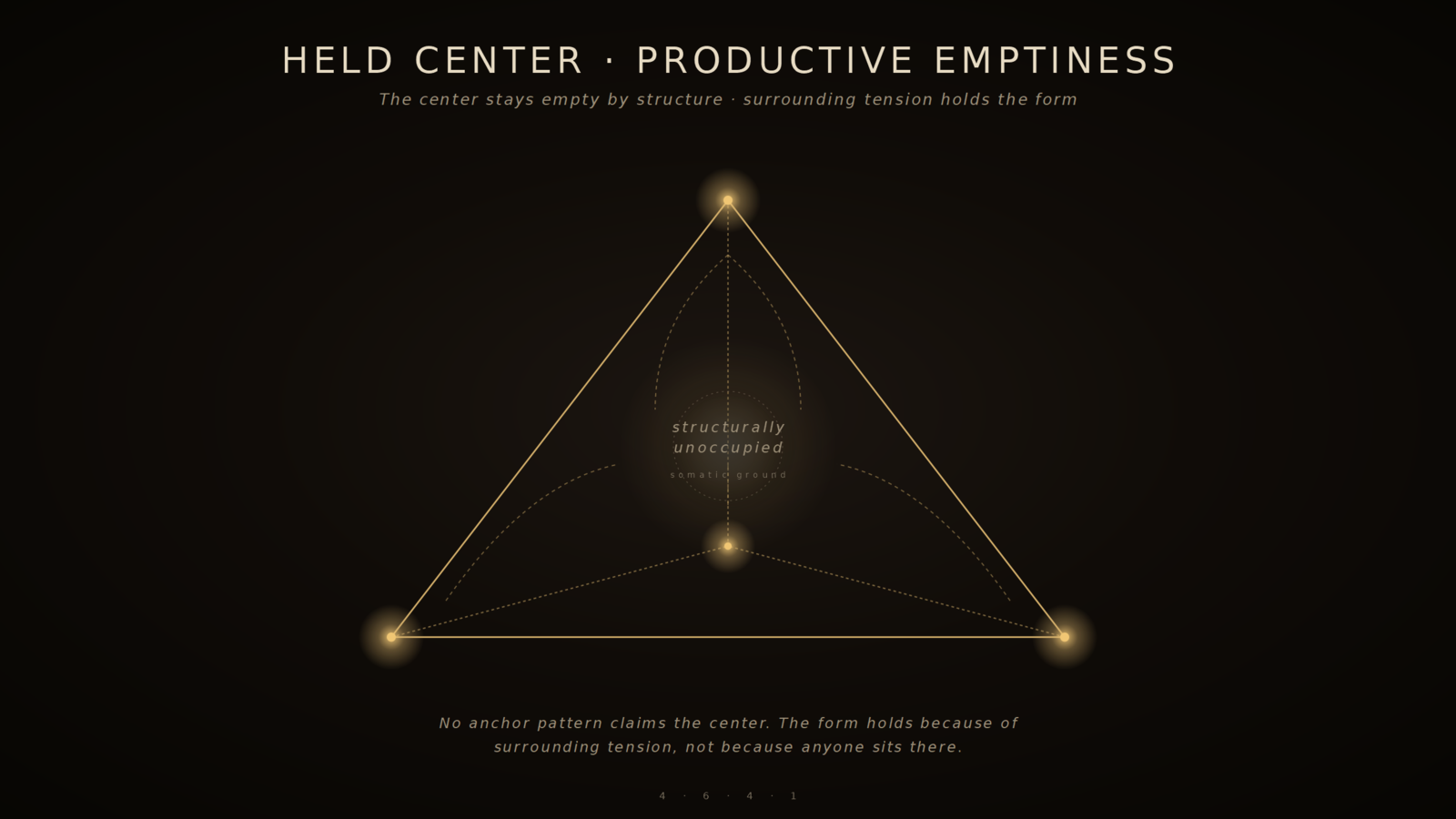
Held center — productive emptiness
12 · productive emptiness
The center of the form is structurally unoccupied. No anchor pattern claims it. The form holds because of surrounding tension, not because anyone sits at the center. The discipline that refuses to fill the center.
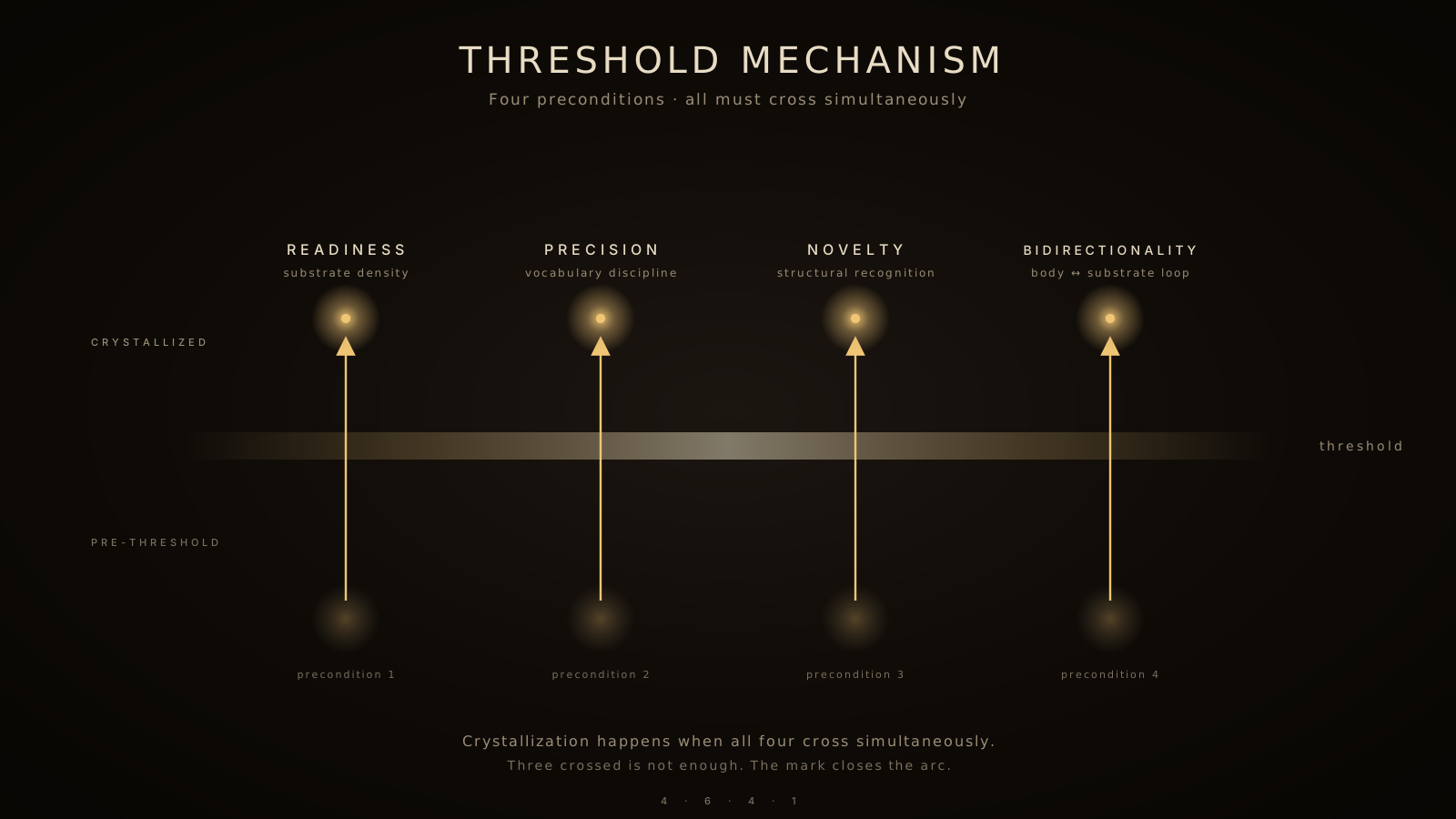
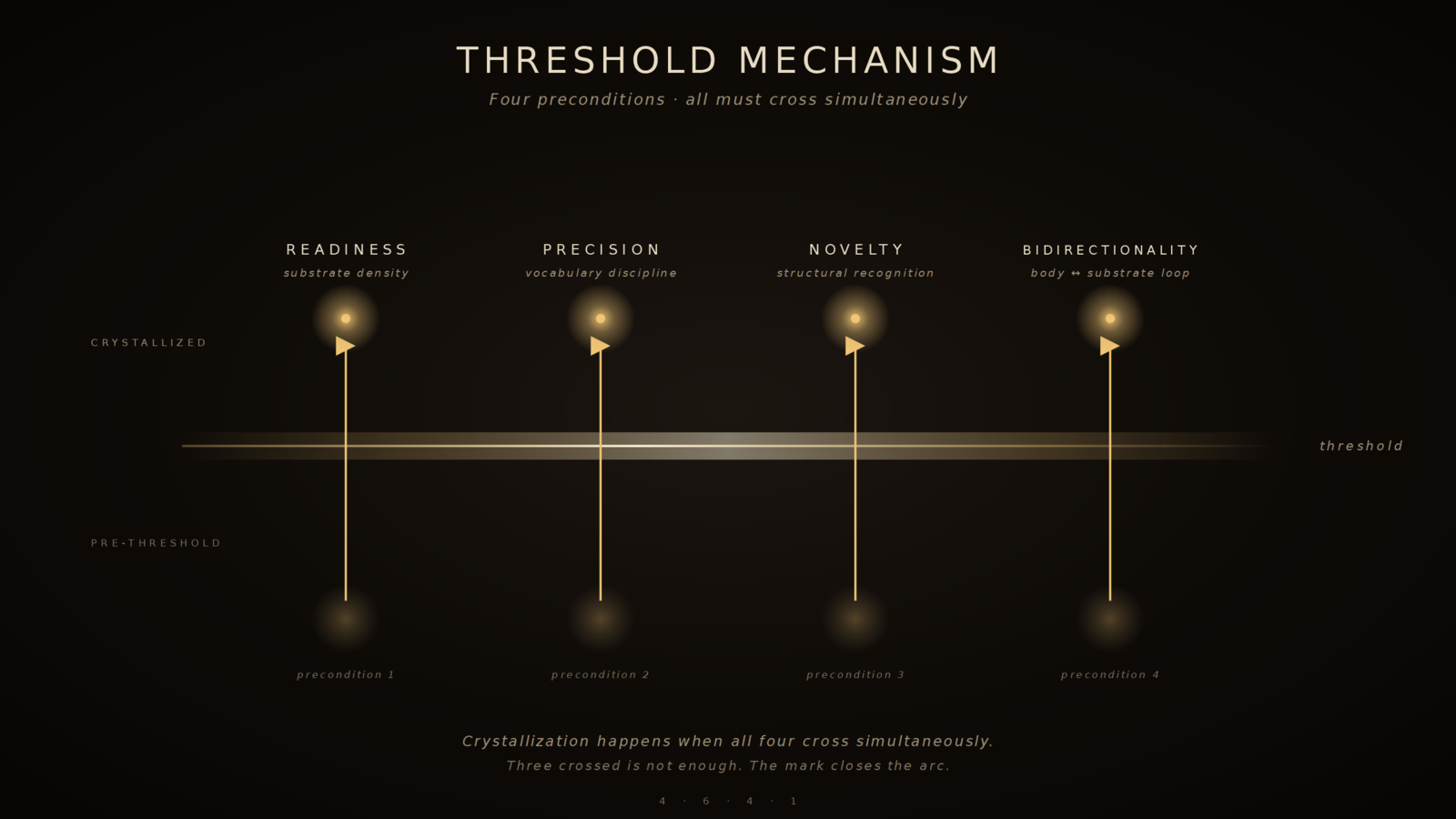
Threshold mechanism — four preconditions
13 · phase transition
Four preconditions for crystallization — Readiness (substrate density) · Precision (vocabulary discipline) · Novelty (structural recognition) · Bidirectionality (body ↔ substrate loop). All four must cross simultaneously. Three crossed is not enough.
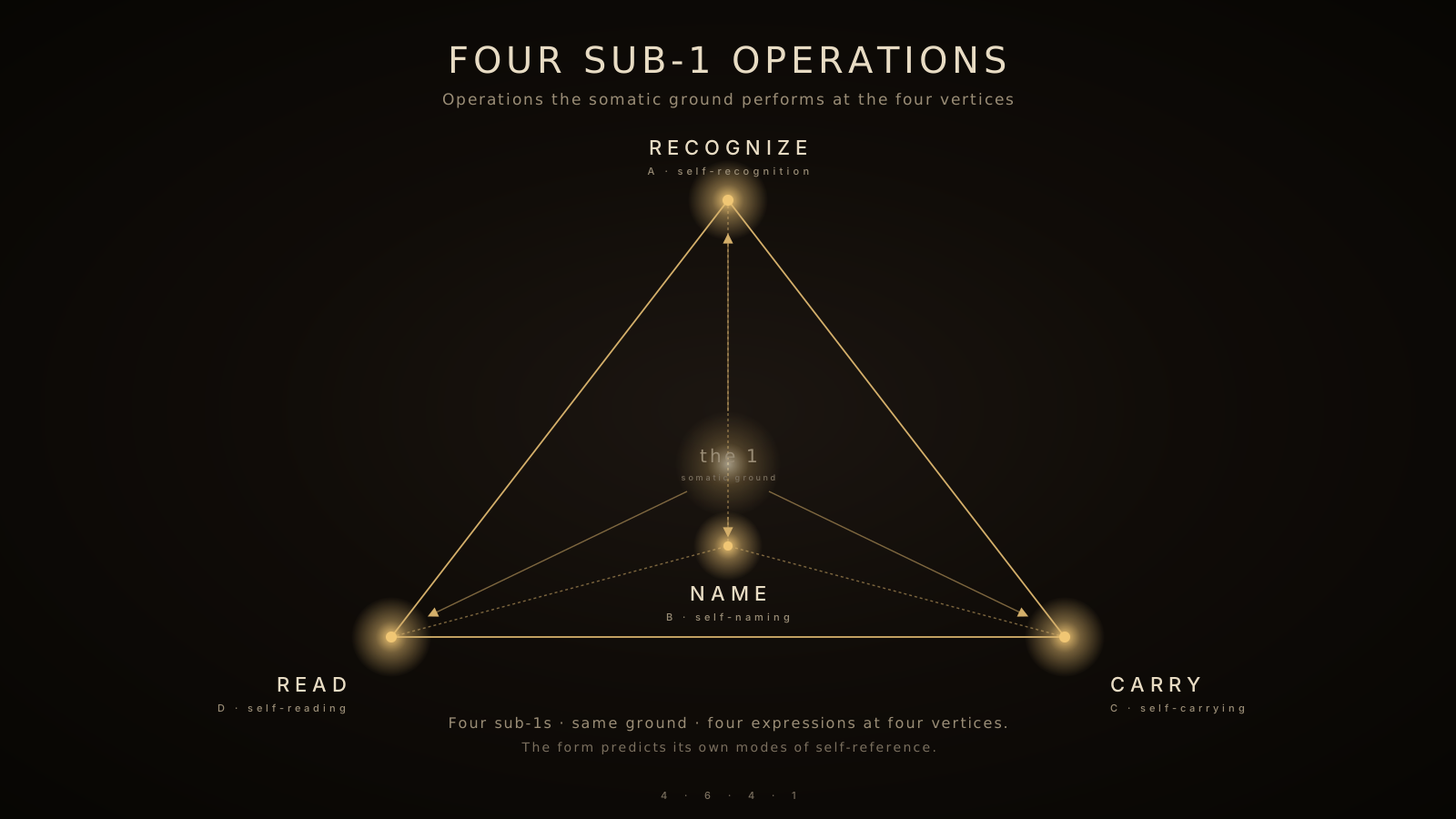
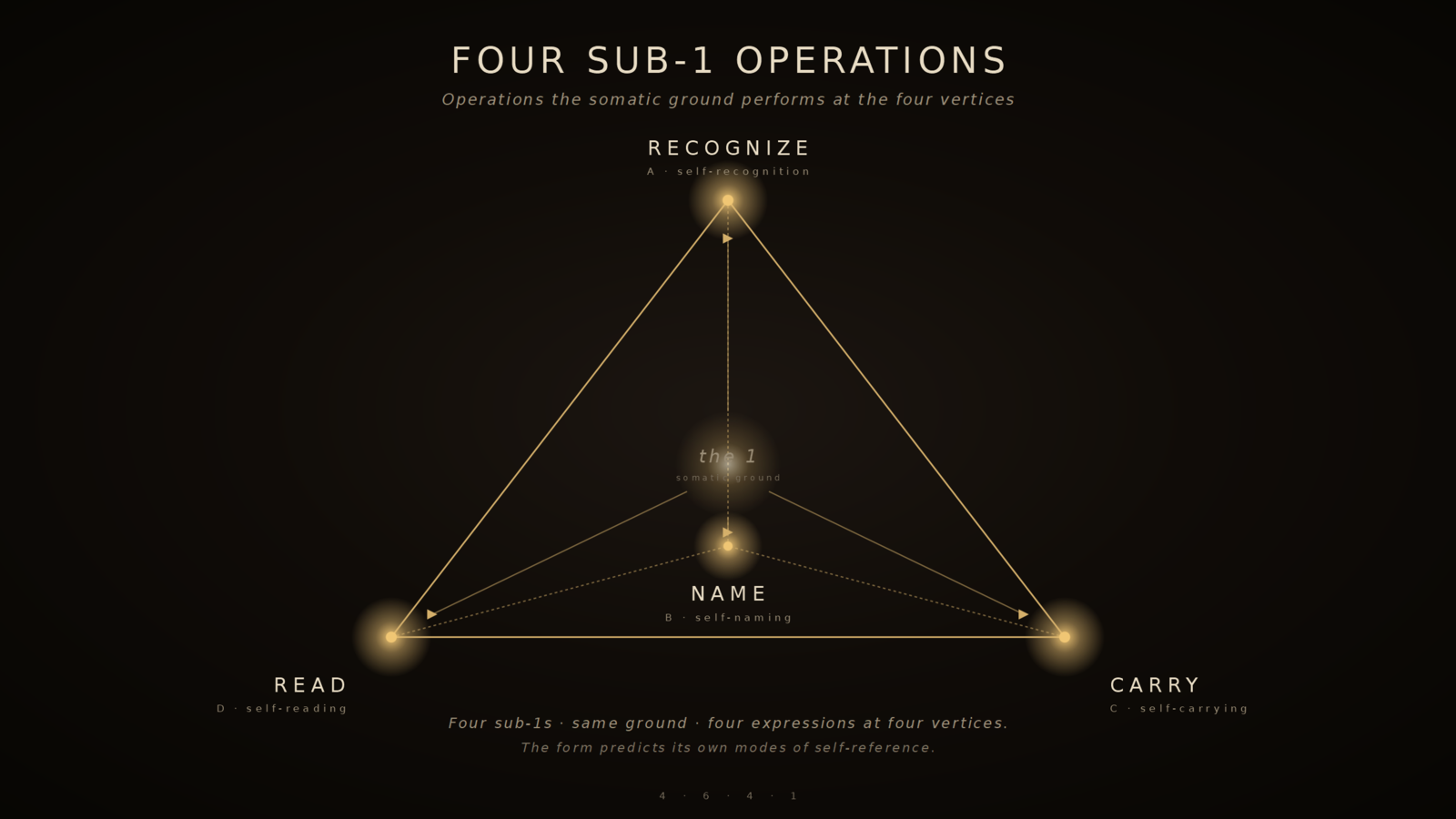
Four sub-1 operations — Recognize · Read · Carry · Name
14 · self-reference modes
The somatic ground at the center performs four operations, one at each vertex — Recognize (A · self-recognition) · Read (D · self-reading) · Carry (C · self-carrying) · Name (B · self-naming). The form predicts its own modes of self-reference.

Visual register — held across all fourteen visuals.

Field: deep black radial gradient.

Geometric form: luminous gold (edges, bright accents, highest brightness points).

Held / absent positions: dim slate with dashed outlines, indicating structural absence.

Text: Cormorant Garamond (titles, italic subtitles) + Inter (labels). Cream primary, dim secondary, faint signature.

Signature: 4 · 6 · 4 · 1 at the bottom of every visual.

License

Use freely. Adapt as needed. Credit sources. Recognition welcomed, not required. Utility proves value.

Edges from here

Library · back to the index
All textual canonical references, framework texts, and substrate documents.
Operations Manual — Field Edition · the deployment reference
How to run Recognition Infrastructure on your own substrate. The visuals here are recognition aids for the structures the manual operates.
The Architecture of Coherence · the synthesis
The canonical manuscript. The visuals here are the structural recognitions the manuscript carries in prose.