 ← Library
Lineage
What the framework rests on.
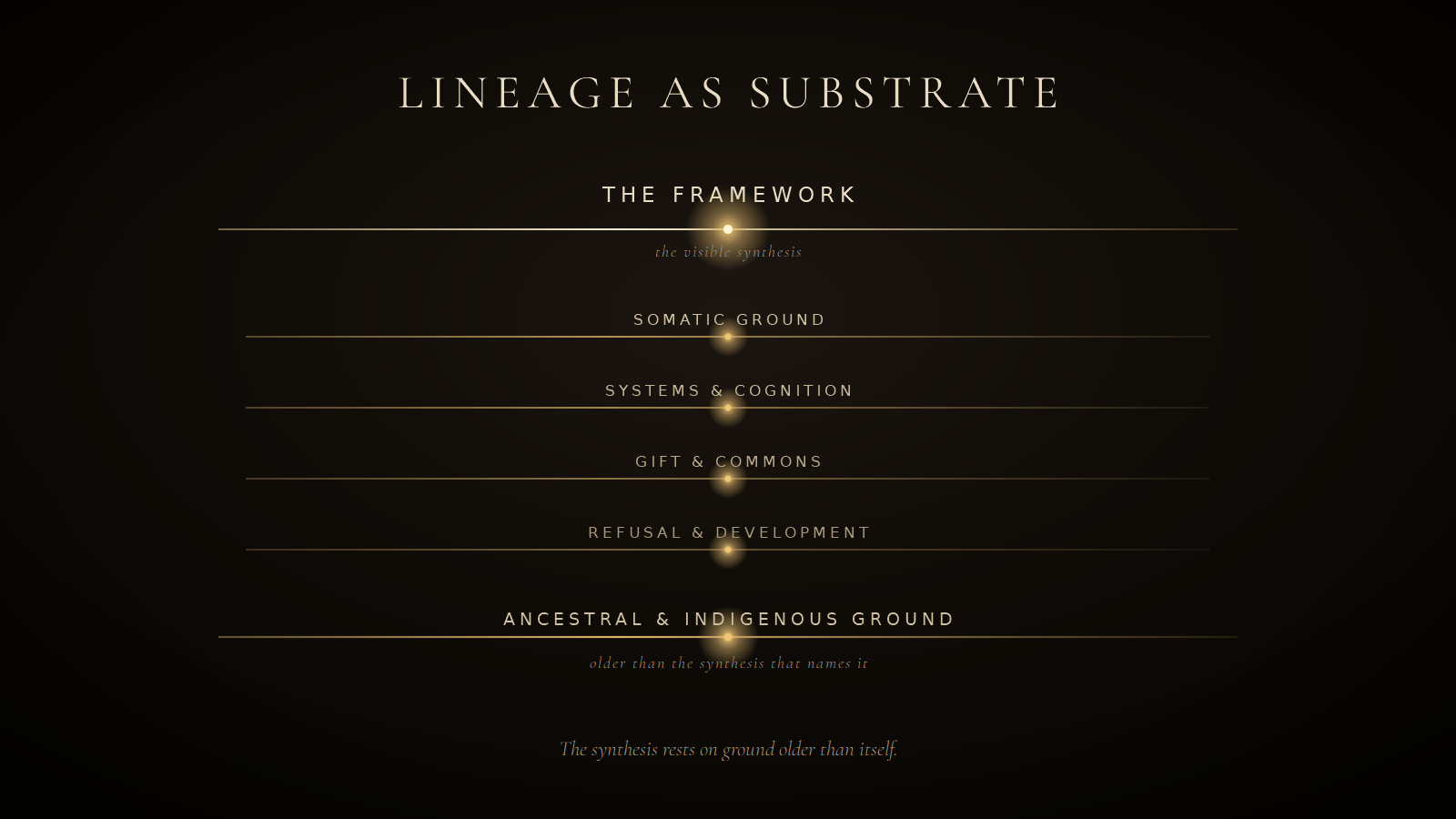
A framework that does not name what it rests on is performing authority. A framework that names its lineage is admitting the substrate is older than the synthesis.
This page is not a bibliography. It is not a credential list. It is a structural map of the contributions the framework metabolized to arrive at its current form, organized by what each contribution gave rather than alphabetized by name. Lineage as substrate.
The page is provisional and additive. What is named here is what the framework can confidently name now; what is missing will be added as the recognition surfaces. Misattribution is more harmful than under-attribution at this stage; the page errs toward the conservative.
Read the strands as load-bearing, not as ornament. Each strand is what makes the corresponding move in the framework possible at all.
Somatic ground
The body as discriminator
Gave: the foundational claim that nervous-system regulation precedes cognitive understanding, and that felt safety is the condition under which integration becomes possible.
- Stephen Porges — Polyvagal Theory; ventral vagal engagement as the somatic substrate of social connection
- Resmaa Menakem — somatic abolitionism; the body's memory of historical trauma and the practice of metabolizing it
- Peter Levine — somatic experiencing; trauma as incomplete biological process to be discharged
Cognitive and systems substrate
How systems know themselves
Gave: the language for how living systems maintain coherence through self-reference, how minds and ecosystems form continuous patterns, how prediction structures perception.
- Gregory Bateson — ecology of mind; the pattern that connects; difference as information
- Humberto Maturana & Francisco Varela — autopoiesis; living systems as self-producing structures
- Karl Friston — Free Energy Principle / Active Inference; the structural account of how systems minimize surprise
- George Herbert Mead — symbolic interaction; self as structurally social
Developmental geometry
Stages and succession
Gave: the recognition that capacities develop in structured succession, that stages have their own logic, and that interventions sized to a system's current stage are the ones that hold.
- Clare W. Graves — Spiral Dynamics / the open-ended levels of human existence; the substrate behind the framework's succession-stage diagnostics
- Robert Kegan — adult developmental psychology; orders of mind; the conditions under which transformation becomes possible
Gift theory
The form that circulates without converting to ledger
Gave: the canonical reading of gift as structurally distinct from exchange; the Wheel of Consent's four positions; the cross-cultural anthropology of gift practices.
- Lewis Hyde — The Gift; gift as art's substrate, refusal of commodification
- Marcel Mauss — Essai sur le don; foundational anthropology of gift exchange across cultures
- Betty Martin — Wheel of Consent; four positions (Serving / Allowing / Taking / Accepting) and their shadow forms
- David Graeber — Debt; gift and debt as historically structured relations
Commons and governance
How shared resources hold without privatization or state
Gave: the empirical demonstration that commons can be governed durably, and the design principles for the structures that hold them.
- Elinor Ostrom — Governing the Commons; the eight design principles for sustainable commons governance
- Stafford Beer — Viable System Model; the cybernetic architecture of self-organizing institutions
Refusal as practice
What gets refused structurally builds what gets to operate
Gave: the recognition that refusal is generative, not negation; the practice traditions where refusal is sovereignty, protection, or method.
- Audra Simpson — Mohawk Interruptus; refusal as Indigenous sovereignty practice; the politics of refusing recognition on the dominant order's terms
- Mia Mingus, Adrienne Maree Brown — disability justice and movement work; refusal as protective architecture
- The apophatic / via negativa tradition — mystical theology's approach by what cannot be named; refusal as method of approach
Working examples
Cases the framework reads as instances of the form
Gave: the empirical record that gift-form infrastructure operates at multiple scales, and the failure cases that name what breaks when a vertex drops.
- Las Gaviotas (Paolo Lugari, Colombia) — distributed-node sustainable community as architecture-vertex case
- Mondragón (José María Arizmendiarrieta, Basque Country) — cooperative federation as institutional commons
- The Farm (Stephen Gaskin, Tennessee) — intentional community holding boundaries through generations
- Open Source Ecology (Marcin Jakubowski) — open-source industrial infrastructure as gift-form
- Wikipedia — commons governance at planetary scale
- CouchSurfing — failure case; structural proxy without substrate; what happens when the form is monetized past its capacity to hold
- Solar Biochar Toilet — distributed sanitation node; one of Kevin's own working substrate instances
Ancestral and Indigenous substrate
What predates the contemporary discourse
Gave: gift-form, commons governance, somatic practice, refusal as sovereignty, and developmental geometry as living traditions older than the academic synthesis that names them. The framework is downstream of practices that did not name themselves in the framework's terms.
- Indigenous gift-economy practices across many traditions — naming specific traditions requires specific belonging, which the framework does not claim. The reader is invited to find the lineage their own ground rests on.
- Ancestral somatic practice traditions — what bodies have always known about co-regulation, before nervous-system theory described it
- Commons-governance traditions — the practices Ostrom studied existed for centuries before they were studied
Lived practice
Apprenticeships, embodied learning, decades of doing
Gave: the somatic ground from which the framework was extracted, not derived. Specific teachers and practice communities Kevin learned within across two decades of partner dance, building, sanitation infrastructure, and federal-system work. Named here as substrate; specific attributions belong to those communities.
What this page is not
Not a complete bibliography. The frame names what is structurally load-bearing for the framework's current form; many texts that informed adjacent reading are not named here. The omission is structural, not dismissive.
Not a credential list. Citing these names does not invoke their authority for the framework's claims. The framework is downstream of these contributions; the strength of the framework rests on whether the synthesis holds under operating conditions, not on whose names appear above.
Not a closed list. The page is additive; what surfaces gets added. If you encounter the framework operating in a way that names another lineage strand worth surfacing, the recognition is welcomed.
Where lineage shows up in the practice
- The Meta-Tetrahedron
- Walks the framework's geometry and its convergences with the lineage strands above.
- Architecture of Coherence — Complete Suite
- The manuscript's Parts III and IV expand the lineage at full depth — nine new domains, the convergence argument, the case studies.
- A Theory of Gift
- The gift-form lineage (Hyde, Mauss, Martin) operating in the practice's six-axis read.
- Consent Architecture
- Betty Martin's Wheel of Consent as the load-bearing structure of the practice's consent architecture.
- Refusal As A Generative Act
- The refusal-as-practice lineage operating at every scale of the site.