 ← Library
A Theory of Gift
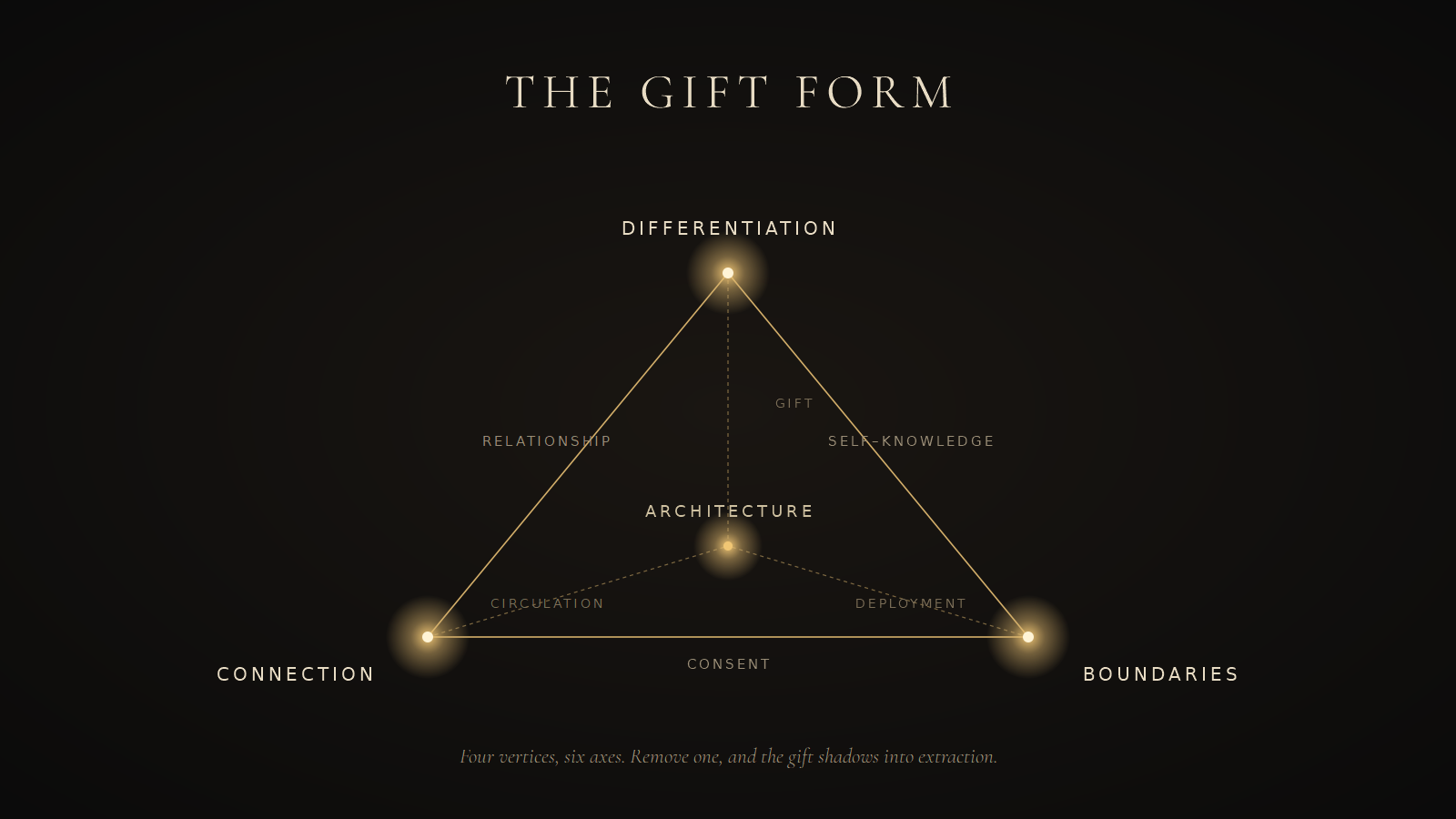
Six operational axes of the gift form.
A gift is not a thing transferred. A gift is the form that circulates between distinct beings without converting their relation into ledger.
Most theories of gift treat the form as one principle — generosity, reciprocity, surplus. This is one principle naming, not enough structure. The gift form is geometric. It has six operational axes, and what looks like generosity in one direction often turns out, on closer reading, to be extraction in another. The axes name where the gift form holds and where it shadows into something else.
What follows is not a theory in the academic register. It is a structural read of how the gift form operates in this practice, with the practice itself as the working example. The axes are the six edges of the framework tetrahedron — see The Meta-Tetrahedron for the full geometric form. The Library treats each edge as an operational axis the gift form moves along.
Read each axis with one situation in your own life in mind. The axis is the medium; the situation is what the axis reads through.
The six axes
1 · Relationship
Differentiation ↔ ConnectionThe axis along which two distinct beings come into actual contact without collapsing into one. A gift travels here only when the giver remains the giver and the receiver remains the receiver — when the contact does not erase the distinctness on either side.
Operates in this practice: The site speaks about Kevin in third person. The infrastructure is specific without being central. About names this as architectural, not stylistic — the operator stays named, the operator stays not-subject.
2 · Self-Knowledge
Differentiation ↔ BoundariesThe axis along which what you know about yourself becomes how your limits show up. A gift the giver does not know is theirs to give will not be received cleanly. A gift the giver gives past their own capacity will arrive shaped by that overrun.
Operates in this practice: The Refusals page names eleven extraction patterns the practice refuses by structural choice — limits stated as information, derived from named substrate, not from rule-making. The Current State page makes capacity visible.
3 · Gift
Differentiation ↔ ArchitectureThe axis along which what is distinctly yours becomes something that persists after you give it. The gift edge is where personal capacity deposits into infrastructure — substrate that outlasts the giver and keeps circulating in their absence. A gift that requires the giver's continued presence to operate is something else: dependency, performance, theater.
Operates in this practice: The framework itself — manuscript, kit, recognition cards, transmissions — is self-licensed substrate that operates without Kevin. The Transmissions archive demonstrates the engine producing assets that travel without him.
4 · Consent
Connection ↔ BoundariesThe axis along which contact and limit work together rather than against each other. Consent in gift form is not a clause; it is the moment-by-moment structural agreement that lets the contact happen at all. The Wheel of Consent — Serving / Allowing / Taking / Accepting — names the four positions consent can hold. Each has a shadow form when the position drifts.
Operates in this practice: Every gift offering names its Wheel-of-Consent quadrant explicitly. The consultations page makes commons-work consent the load-bearing structural arrangement: patterns from engagements may circulate, generalized and anonymized; the receiver consents to this before engaging.
5 · Circulation
Connection ↔ ArchitectureThe axis along which contact between distinct beings produces something that keeps moving after the contact ends. A gift that circulates does not return to its giver as repayment; it travels onward, picking up new ground, becoming part of substrate that other practitioners can rest on. Circulation is gift form's propagation pattern.
Operates in this practice: The Toolkits vertex holds four live tools that travel without Kevin. The Recognition Threshold transmission demonstrates one cycle of circulation — substrate composed → engine emits artifacts → assets propagate. The self-license ("use freely, adapt as needed, credit sources") is circulation's enabling rule.
6 · Deployment
Boundaries ↔ ArchitectureThe axis along which limits become operational rather than aspirational. Deployment is where the gift form's discipline gets wired into the infrastructure itself, so the limit holds without continuous attention. A gift form without deployment dissolves under its first stress test; the form survives only as long as the giver actively defends it.
Operates in this practice: The Automation vertex names limits made operational — capacity ceilings, fit filters, receiver-shaped intake, structural refusals. The Fit Filter is the prototype of this edge: a tool that operates a limit (consultation tier fit) without requiring Kevin's per-receiver judgment.
The shadow operations
Each axis has a shadow form — a way the same structural move becomes extraction rather than gift. The shadows are not failures of intention; they are the gift form's own geometry running in reverse when one vertex drops out of the integration.
Reorganized through the four anti-extraction axes (one per vertex's shadow, per Refusals):
| Vertex | Gift-form move | Shadow operation |
|---|---|---|
| Connection | Distinct beings come into actual contact; value flows between them as they remain themselves | Capture — flow becomes one-way taking; the receiver is converted into a source |
| Differentiation | Each being knows what they are; the gift comes from somewhere specific | Aggregation — distinctness collapses into score, follower count, reputation metric |
| Architecture | What works gets built into infrastructure that outlasts the builder | Scaling — persistence becomes growth; depth becomes reach; the gift form converts to product |
| Boundaries | Limits are information; the gift form's discipline holds operationally | Performance — visible form replaces structural function; the gift becomes its own theater |
This is why the gift form requires all four vertices and all six axes to hold simultaneously. A gift form running on three vertices defaults into a specific failure pattern; the missing vertex names the shadow.
Same form, different ground
The six axes manifest differently across substrates. The medium of the gift changes — what counts as a clean gift in the technical substrate (an executable artifact, a contract, a test) is not what counts in the biological substrate (an embodied sequence, a regulated state) or the relational substrate (a speakable sentence, the named pattern). The form is the same. The medium is what the substrate makes possible.
See The Four Substrates for the comparison matrix — same vertices, four substrates, distinct media of the gift.
Why this matters operationally
The six-axis read is what lets the gift form hold under pressure. Each axis has to operate. Each shadow has to be refused at the design stage. The medium of the gift has to match the substrate it's moving through. A gift form running on three vertices defaults into the failure pattern of the missing vertex — dissolved, isolated, overflowing, or ephemeral. The form's integrity depends on all four vertices holding simultaneously, all six axes operating, all four shadow operations named and refused.
Where this axis-set operates in the practice
- Offerings
- Gift edge made visible — six offerings, each with its Wheel-of-Consent quadrant named.
- Refusals
- The four shadow operations of the four vertices, with eleven specific extraction patterns the practice refuses.
- Consultations
- Consent axis made structural — commons-work arrangement, patterns circulating with anonymization, the receiver consenting before engagement.
- Donate
- Donor discipline as the deployment of the Boundaries vertex — limits the platform doesn't enforce, held operationally.
- The Four Substrates
- The axes' media across biological, institutional, relational, technical.
- The Meta-Tetrahedron
- The full geometric form the six axes belong to.
Lineage
This synthesis rests on Lewis Hyde's The Gift, Marcel Mauss's foundational Essai sur le don, Betty Martin's Wheel of Consent, and the broader Indigenous and gift-economy traditions the framework reads through. Specific attributions in the Library lineage entry when that synthesis lands.