 ← Library
Seven Case Portraits
The framework reading specific cases from different angles.
A case portrait names what is structurally visible in a specific instance, without the framework explicitly appearing inside the case. The pattern shows itself; the language for the pattern lives on this page.
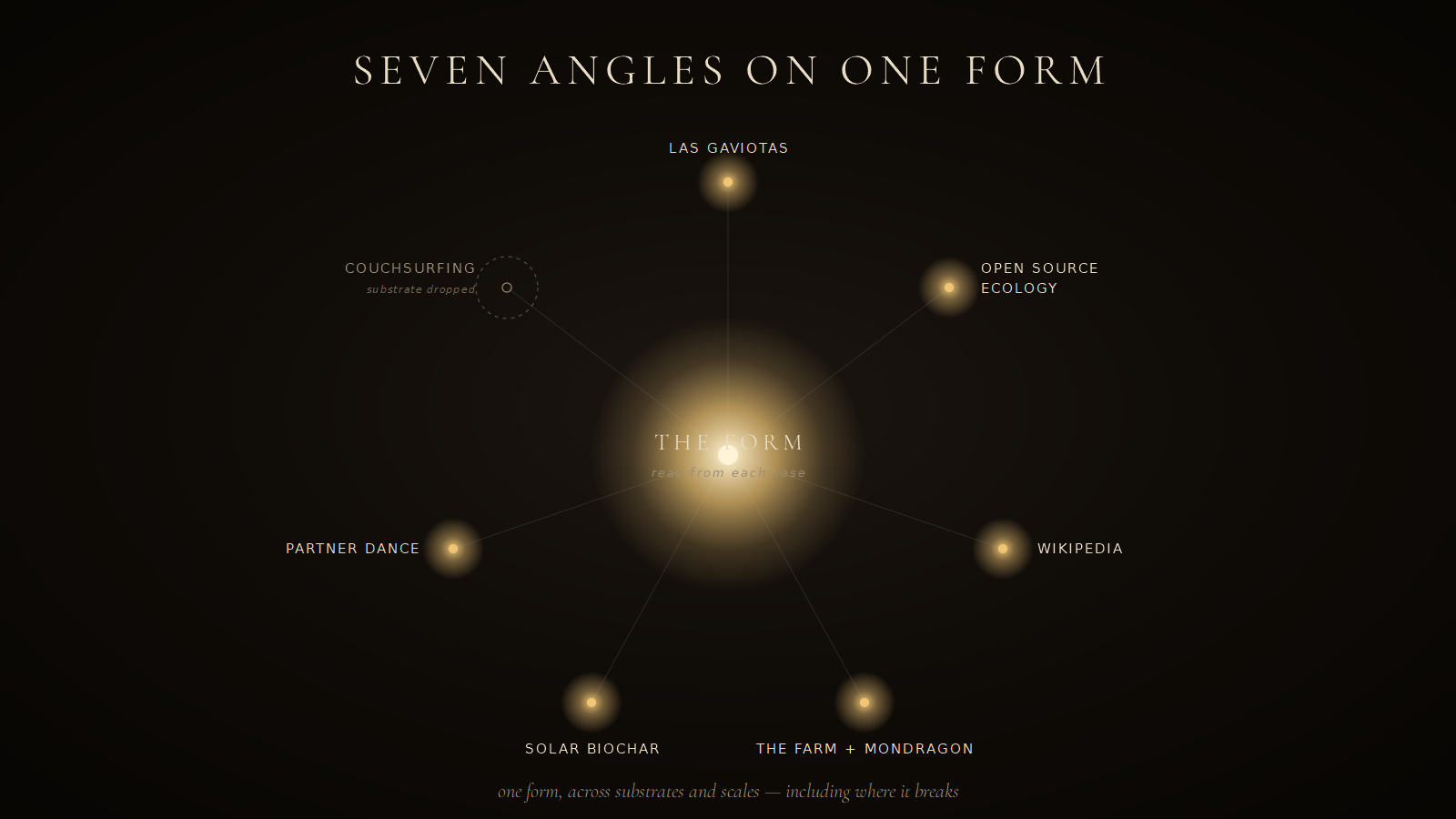
The framework reads each case as one angle on the form operating. Some cases instance the form holding across decades; some instance the form's specific failure when one vertex drops; some instance the form at scales the rest of the framework only describes. The seven together name the form's range — across substrates, across scales, across success and failure.
The case portraits are not exhaustive. They are the cases the framework has metabolized far enough to read structurally. Other cases — many — would extend the set; the seven here are the load-bearing instances.
Read each portrait with one case from your own knowing in mind. Notice which framework move each portrait surfaces; notice which moves your case would surface that this set does not.
Las Gaviotas
Las Gaviotas
A research village in the Colombian llanos that, across decades, built distributed infrastructure — solar water pumps, sanitation, low-cost technologies for tropical conditions — and reforested savanna into a self-sustaining tropical forest. The site operates as both working community and open-source technology source; the patents on its designs were released for free public use.
The framework readsArchitecture vertex at communal-to-bioregional scale. The infrastructure persists across founder transitions, across funding shifts, across decades. The reforestation was the move that made Las Gaviotas a substrate-producing site rather than just a working community — it now generates conditions other sites can grow into. Gift form at infrastructure scale: the technical designs are self-licensed and travel beyond Las Gaviotas while the apparatus that built them stays in Vichada.
CouchSurfing
CouchSurfing
Originally a peer-to-peer hospitality network operating in gift form — hosts offered shelter to travelers without payment, and the system held on trust, mutual reference, and the relational density of repeated participation. In 2011 the structure converted to a for-profit company; verified-host fees, paid membership tiers, and engagement-metric design followed. The gift form did not survive the conversion.
The framework readsThe reference failure case: structural proxy without substrate. The visible form (peer-to-peer hospitality, member references, no per-transaction payment) was preserved through the conversion. The invisible substrate (felt safety, mutual commitment across density, the gift form's refusal of ledger logic) was not. The shell of the original infrastructure remains; the practice that the shell carried does not. The pattern recurs in many gift-form-monetized cases; CouchSurfing is named in the framework as the canonical instance of this failure mode.
Partner dance
Partner dance
The social-dance tradition operates in the relational substrate at the level of moment-by-moment somatic coordination. Two dancers, an agreed-on form, a frame that holds the partnership, real-time mutual movement that lives in the body before the cognitive system catches up. Lead and follow as structural positions that pivot mid-dance, not fixed roles.
The framework readsConnection vertex made visible at the somatic register. Co-regulation operating in real time — heart rates synchronize, ventral vagal tone rises, the threat system stands down. The Wheel of Consent is enacted moment-by-moment: who is leading (Serving), who is following (Accepting), the small refusals that redirect a movement, the larger refusals that end a dance cleanly. Twenty years inside this substrate is part of where the framework's somatic ground was extracted from.
Open Source Ecology + OpenCivics
Open Source Ecology + OpenCivics
Open-source design and construction blueprints for industrial machines (OSE's Global Village Construction Set: tractors, brick presses, lathes, etc.), released for free public use, with the apparatus to manufacture them at small scale and replicable cost. OpenCivics extends the pattern to civic infrastructure — governance tools, deliberation processes, commons-management designs as open source.
The framework readsArchitecture vertex in the technical substrate at infrastructure scale. The Gift edge (Differentiation ↔ Architecture) made operational: specific designs that persist past their originators and travel as form. The apparatus/form distinction visible — OSE's workshop in Missouri is the apparatus; the blueprints are the form that travels. Recognition threshold crossed when other practitioners build their own version on their own ground.
The Farm + Mondragón
The Farm + Mondragón
Two intentional communities at very different scales, joined here because both demonstrate institutional architecture holding across leadership transition. The Farm: spiritual community founded by Stephen Gaskin that survived its founder's departure and decline by restructuring its membership model and economic base. Mondragón: cooperative federation founded by José María Arizmendiarrieta that now spans hundreds of worker-owned enterprises across multiple sectors, decades after the founder's death.
The framework readsBoundaries vertex paired with Architecture vertex. The institutional form survives leadership transition because the architecture is in the artifacts (charters, decision-rights documents, cooperative legal structure) rather than in the founder. The boundaries are operationalized — limits stated as information, codified in the cooperative agreements, enforceable without requiring the founder to be present. The case for what institutional infrastructure looks like when it works.
Solar Biochar Toilet
Solar Biochar Toilet
A sanitation system that converts human waste into biochar through a solar-heated pyrolysis chamber, designed for distributed operation at communal-to-individual scale, with the technical specifications released for adaptation and replication. The build sits in the technical substrate at communal scale; the infrastructure is replicable without the originator present.
The framework readsArchitecture vertex at communal scale in the technical substrate. The build is one substrate-bearing instance the framework was extracted from rather than derived to fit. The Gift edge operating: substrate (the design, the engineering, the operating notes) deposited into something that persists and travels. The distributed-node pattern visible: each unit is independent of the others; the system scales by replication of the unit, not by centralization.
Wikipedia
Wikipedia
The largest working example of commons-governance gift-form infrastructure: an encyclopedia maintained by volunteer editors, governed by community-developed policies, hosted by a nonprofit foundation, free to access and modify under a permissive license. Held together by procedural commitments, role differentiation, and conflict-resolution architectures the community developed iteratively.
The framework readsAll four vertices visible at planetary scale. Differentiation: each article distinct, citation discipline, scope statements. Connection: editor community, talk pages, real exchange across edits. Boundaries: the policies (notability, neutral point of view, verifiability), the dispute-resolution processes, the lock mechanisms. Architecture: the encyclopedia itself as artifact, the infrastructure that persists past any individual editor or administrator. The case for the form operating at the largest scale the framework currently observes it at.
What the seven together name
- Across substrates
- Las Gaviotas (technical at communal), partner dance (relational somatic), The Farm + Mondragón (institutional), Wikipedia (institutional at planetary), Solar Biochar Toilet (technical at communal), Open Source Ecology (technical at infrastructure), CouchSurfing (relational/institutional, failure). The form operates across all four substrates.
- Across scales
- From two-person dance to planetary Wikipedia. The framework's geometry operates fractally; the cases instance specific scales.
- Including failure
- CouchSurfing is named explicitly. A case set that only includes successes is not a structural read; it is a celebratory list. The failure case names what breaks when the substrate is not held, and is structurally as important as the cases that hold.
- Working examples not utopias
- None of the cases are perfect. Each has its specific failure modes, its specific compromises, its specific places where the form holds and places where it does not. The portraits read what is structurally visible without claiming the case is complete.
Why portrait form, not case study
A case study analyzes from a remove — assembling evidence, building an argument, drawing conclusions about what the case demonstrates. The form requires the analyst to take a position on the case. The position then has to be defended; the case becomes evidence for the analyst's claim.
A case portrait names what is structurally visible without arguing the framework's claim. The reader sees the pattern in the case directly; the framework provides language for what was seen. The portrait does not need to defend; the case does its own work.
This is also a refusal of the academic register's distance from its subject. The portrait stays close. The pattern shows itself.
Where the case-portrait method shows up
- Architecture of Coherence — Complete Suite
- The manuscript's Part V expands the case portraits at greater length, with the convergence argument that the seven together name.
- The Meta-Tetrahedron
- The geometric form the cases all instance, at their respective scales.
- A Theory of Gift
- The gift form operating across the cases; each portrait shows the form at a different angle.
- Invisible Infrastructure of a Village
- The village-scale cases (Las Gaviotas, The Farm, Mondragón) instance what invisible infrastructure looks like when it holds.
- Lineage
- The case attributions and the practitioners who built the working examples.
Lineage
These portraits rest on the practitioners who built and maintained the cases (Paolo Lugari and Las Gaviotas's contributors; the CouchSurfing community as it operated in gift form; the social-dance lineages — instructors, communities, and the long tradition of partnered movement; Marcin Jakubowski and the OSE community; Stephen Gaskin and The Farm; José María Arizmendiarrieta and the Mondragón cooperatives; the Wikipedia editor community across two decades); and on the case-study traditions in commons research, intentional-community documentation, and open-source ecology that made the cases legible to outside practitioners. Specific attributions in the Lineage entry.