 ← Library
Twelve Failure-Mode Patterns
What breaks when a vertex drops.
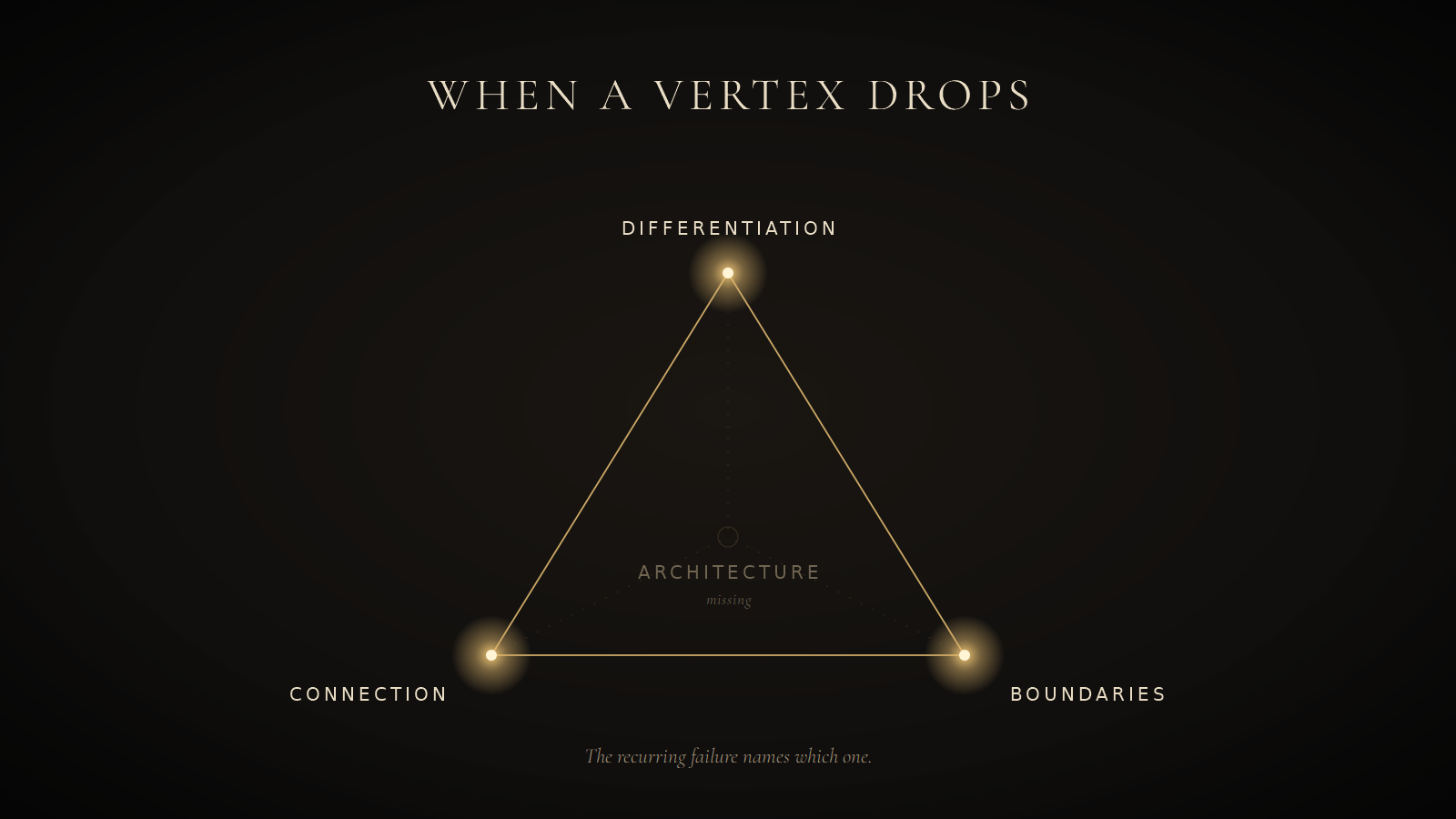
A failure pattern names which vertex is missing. The corrective is to restore the vertex, not to fight the pattern. Patterns that recur are diagnostic: the system has been operating without one of the four functional capacities, and the recurrence is the system telling you which one.
The framework treats failure as structural information. When a system breaks the same way repeatedly, the breakage is not the problem — it is the symptom of a missing vertex. The four faces of the form name the four missing-vertex states. Each face has three specific patterns the framework reads at it.
Twelve patterns total. Three per face. The breakdown is structural: there are exactly four ways the form can fail (one per vertex), and within each failure mode, the patterns vary by how the missing vertex shows up at the surface level.
Bring a system you know that has broken in a recurring way. Read the twelve patterns; find which one matches. The match names the missing vertex. The vertex names the corrective.
Dissolved
Nothing knows what it is. Position cannot hold. Trust cannot form because there is nothing distinct enough to trust.
The Transaction Trap
Every decision requires rigid contract. Documentation, sign-off, CYA email substitute for clarity. Score-keeping becomes the operational substrate; trust never gets the chance to form because the system has structured the ground that would have grown it.
Corrective: name what each role actually owns. Make distinct again what has been blurred.
Role-Collapse
Everyone takes on whatever's needed, regardless of role. From inside it looks like flexibility; from outside it looks like soup. No one can describe their specific contribution; the team operates as undifferentiated bandwidth rather than as coordinating distinct capacities.
Corrective: name what is mine, what is yours, what is ours. Make ownership visible.
Position-Blur
If asked "what is your specific contribution that no one else makes" — most members would struggle to answer. Disagreements collapse into shared positions before the actual difference gets examined. Each person's distinct perspective gets absorbed into the group's average shape.
Corrective: ask the question. Make people state what they specifically bring that others do not.
Isolated
Distinct elements exist but do not actually exchange. The form of contact is preserved; the substance of contact does not occur.
The Poison Gift
Gestures of contact are present — meetings, check-ins, care offered — and no actual exchange occurs. The form is intact; the substance has gone. Both sides sense the absence; the form's correctness makes it hard to name.
Corrective: ask what changed because of the contact. If nothing did, the contact has not happened yet.
Parallel-Presence
There is proximity — shared channels, shared calls, shared space — but the substantive conversations happen elsewhere, or not at all. The container is operational; what was supposed to happen inside it is happening in side conversations, private DMs, or nowhere.
Corrective: notice where the actual exchange is happening, and either bring it into the container or stop pretending the container is what's holding the work.
Performed-Alignment
Alignment meetings produce records of alignment without producing the thing. The team confirms it agrees; the actions afterward diverge. The artifact of agreement substitutes for the agreement itself; the gap is visible only when the actions reveal it.
Corrective: name what specifically changed about a decision because of the alignment process. If the answer is nothing, the alignment was performance.
Overflowing
Limits are not visible. The system has no edges. Capacity disappears into whatever shows up.
The Burnout Cycle
Someone — possibly you — is consistently performing beyond their actual capacity. The system has adapted to the over-performance. When the limit finally trips, the apparent breakage will be far worse than the actual structural problem, because the over-performance was hiding it.
Corrective: name the limit before it breaks. Make capacity visible as structural fact, not as the performer's private knowledge.
Bad-News-Hiding
Bad news gets softened, delayed, or never surfaced. Surfacing it feels like failure rather than as information. The system optimizes for surface calm; the structural problems compound underneath because nothing can reach the level where decisions could address them.
Corrective: reframe the bad news as data the system needs to function. The cost of hiding it is always higher than the cost of surfacing it; the calculus only looks otherwise because surfacing has a sharp local cost and hiding has a diffuse compounding one.
Capacity-Fiction
Stated capacity diverges from operating capacity. The plan, the calendar, the commitments assume a level of throughput the actual system cannot sustain. The gap stays invisible until something cracks; the cracking arrives as a surprise even though the gap was structurally predictable.
Corrective: measure operating capacity, not aspirational capacity. Then plan to the measured number, with margin.
Ephemeral
Nothing persists. The system operates only as long as someone is actively holding it together.
The Dependency Loop
One person is the runtime of the system. They know how it works; they onboarded everyone informally; they are the documentation. If they stepped away for a month, the system's capacity would collapse rather than redistribute. The system is not fragile because of them; it is fragile as them.
Corrective: the person at the center withdraws and deposits a gift at the threshold — documented process, runbook, charter — that lets the system operate without them.
Same-Problem-Recurrence
The same problems resurface week after week. Nothing accumulates that prevents their return. Each instance of the problem is solved in isolation; the structural pattern that produces the problem never gets named, so it produces another instance.
Corrective: name the structural pattern. Build the artifact (the policy, the check, the architecture change) that makes the next instance impossible rather than solvable.
Surplus-Absorbed-by-Maintenance
When surplus energy appears, it gets consumed by maintaining what exists rather than building what didn't. The system runs in place. Growth never happens because every unit of capacity above bare survival gets absorbed into keeping current-state intact.
Corrective: protect a portion of every surplus for new architecture. Treat building as load-bearing, not as what you do after maintenance is caught up — because maintenance is never caught up.
How to read which pattern is operating
A pattern that recurs is the diagnostic. The framework's read: when you notice the same break happening again, do not address the break directly. Name the pattern. The pattern names the face. The face names the missing vertex. The vertex names the corrective.
The mistake practitioners commonly make is to address the surface symptom. A Transaction Trap addressed with more documentation deepens the trap. A Burnout Cycle addressed by working harder accelerates the breakage. A Dependency Loop addressed by making the dependency more efficient locks it in. The corrective is always the missing vertex, never the surface fix.
The pattern set across substrates
The twelve patterns appear in each substrate with the medium changing:
- Biological
- Transaction Trap → cognitive analysis substituting for body-level knowing. Poison Gift → somatic gestures without co-regulation. Burnout Cycle → body's no overridden until crisis. Dependency Loop → one practice carrying what the body's own architecture should.
- Institutional
- Transaction Trap → process for clarity; meetings about meetings. Poison Gift → alignment without alignment. Burnout Cycle → one role absorbing institutional load. Dependency Loop → founder as runtime; institution can't operate without them.
- Relational
- Transaction Trap → relationship as ledger; fairness calculated. Poison Gift → check-ins without contact. Burnout Cycle → one person carrying the emotional labor. Dependency Loop → relationship meeting one person's needs in a way that prevents them from developing capacity.
- Technical
- Transaction Trap → every change requires meetings with seven services. Poison Gift → integrations technically work; nothing actually changes. Burnout Cycle → one service or engineer absorbing load past capacity. Dependency Loop → one person is the documentation; the architecture diagram lies.
See The Four Substrates for the cross-substrate read and the RI Kit for the diagnostic that routes the four canonical patterns to substrate-specific prescriptions.
Why this matters operationally
Most practitioner attention goes to addressing failures as they appear. The framework treats this as a partial response. The complete response is structural: the failure pattern is information about which vertex is missing, and addressing the vertex is what stops the pattern from recurring.
A system that experiences the same failure pattern three times has named which vertex is structurally weak. The third recurrence is the diagnostic the framework reads at; the corrective is the vertex's restoration, not the symptom's removal.
Where the failure-mode read operates
- RI Kit
- The full diagnostic instrument — 12 questions, four canonical failure patterns, sixteen prescriptions across vertex × substrate. The kit operationalizes the corrective for any specific failure-mode read.
- The Meta-Tetrahedron
- The framework's four faces named geometrically — the four ways the form can fail, one per dropped vertex.
- Seven Case Portraits
- CouchSurfing as the canonical failure-case instance; the seven cases together include both holding and breaking instances of the form.
- Refusal As A Generative Act
- The four shadow operations of the gift form (Capture, Aggregation, Scaling, Performance) are the failure-mode patterns expressed at the gift-form level.
- Quick Diagnostic
- The lighter four-question version — one question per vertex; the weakest answer names the most-likely-operating failure mode.
Lineage
This synthesis rests on the framework's own self-application across decades of practice; on the case-study traditions that documented the canonical failure patterns (commons-governance research, intentional-community studies, organizational-development work); on systems-thinking traditions that treat recurring failure as structural diagnostic (Senge, Meadows); and on the somatic-practice traditions that read the body's recurring patterns as information rather than malfunction. Specific attributions in the Lineage entry.