Recognition Threshold
Why work has to be picked up, and what determines whether it is.
Validation closes a transaction. Recognition opens a use. The work that gets recognized is the work that travels; the work that gets validated stays where it was made.
A piece of work crosses the recognition threshold when another practitioner picks it up and operates with it on their own ground. Until that crossing, the work exists. After the crossing, the work propagates. The threshold is structural — not a matter of reputation, audience, or distribution. It is determined by whether the work has been shaped into a form that can travel without its apparatus.
The piece is upstream of The Meta-Tetrahedron's central claim that the form is portable, the ground is yours. Recognition Threshold is where that pattern first crystallized; the Meta-Tetrahedron operationalizes it across the framework.
Bring a piece of your own work to mind as you read. Notice which of the five frames it is currently sitting in. Most work that hasn't propagated is stuck at one specific frame; finding which one names the friction the work is encountering.
The whole pattern
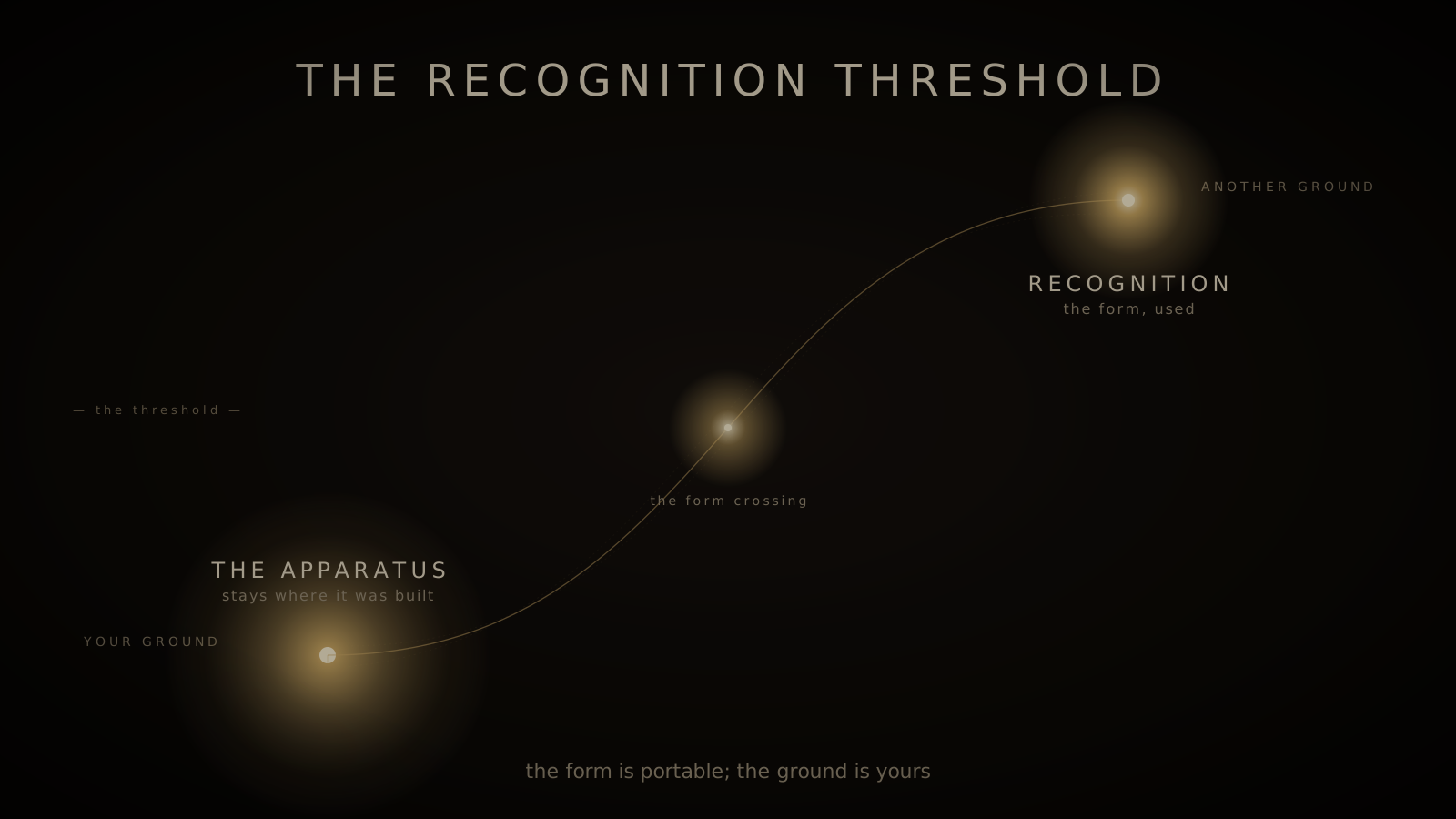
Two grounds, at different elevations. The maker's apparatus stays rooted on their ground. The form arcs across the threshold. Recognition lights up on a different practitioner's ground. The lens travels; the apparatus stays.
The five frames
The work moves through five distinguishable frames between being made and being picked up. Each frame is a different structural condition; each one has its own friction cost; each one has a different failure mode if the work stalls there.
Frame 1Terrain
The ground the maker stands on. Particular, specific, non-portable. The terrain is what the work is made of — embodied experience, lived practice, the substrate the maker has been metabolizing. Work that hasn't found its terrain hasn't started; work that confuses terrain with form will not propagate.
Frame 2Apparatus
The substrate-producing infrastructure built on the terrain. Tools, methods, language, frameworks that let the maker do their work. The apparatus stays where it was built — it is specific to the terrain. Other practitioners cannot use the apparatus directly; they have to build their own on their own terrain.
Frame 3Form
What the apparatus produces. Structurally portable — composed in a way that does not require the apparatus to interpret. A form that can only be read with the maker present, or with proprietary context, has not yet crossed the form threshold; it is still apparatus.
Frame 4Recognition
Another practitioner picks up the form on their own ground. The form fits — not because the receiver imitates the maker, but because the form holds a structure the receiver's own ground can rest it on. Recognition is the moment the threshold gets crossed.
Frame 5Propagation
The form continues by recurring around new grounds. The maker's apparatus does not travel with it; each new practitioner builds their own apparatus on their own terrain, and produces their own form. Propagation is not replication. The form is the same; the ground is different; the apparatus is rebuilt each time.
Recognition vs validation
The conventional success metric for work is validation — the receiver agrees the work is correct, valuable, or worth their attention. Validation is a closing move. It completes the transaction; the receiver acknowledges; the work returns to the maker as confirmation.
Validation
Closes a transaction.
Returns to the maker as agreement.
Says: you are right.
Work stays where it was made.
Recognition
Opens a use.
Travels to other grounds as form.
Says: this is operable here too.
Work propagates beyond the maker.
A framework can be validated by many readers and still cross zero recognition thresholds — read, agreed with, never operated. A framework that crosses recognition thresholds may receive less validation; what it receives instead is practitioners building their own version of it on their own ground. The two metrics are not on the same axis.
The framework treats recognition as the load-bearing signal. Validation is allowed but not optimized for; recognition is the signal that the work has crossed the threshold the form was shaped for.
Friction cost determines pickup rate
The form crosses the threshold only if picking it up is cheaper than the value the receiver expects from operating with it. Friction cost is the structural property of the form that determines this. Forms with high friction cost — requiring extensive context, proprietary tools, the maker's interpretation, a long upfront commitment — cross the threshold less often, even when the underlying work is strong.
Reducing friction cost is the maker's structural responsibility, not the receiver's burden. A form that asks the receiver to do most of the work to make it operable is not yet ready to cross the threshold; it is still apparatus dressed as form.
The Transmission Engine that produced this article's visual asset set exists for exactly this reason — to reduce the friction cost between a written piece and its pickup. The article alone has higher friction cost than the article plus a compression diagram plus pull-quote share cards plus a teaching sequence; the engine emits the lower-friction surface.
Where the threshold operates in this practice
The framework is shaped to cross recognition thresholds at every layer.
Terrain: Kevin's ground — two decades of partner dance, building, sanitation infrastructure, federal-system work. Specific, non-portable. The substrate the apparatus rests on.
Apparatus: The Architecture of Coherence manuscript; The Meta-Tetrahedron's formalization; the RI Kit's diagnostic instrument; the Toolkits producing form for receivers to operate.
Form: The framework's geometric claim — four vertices, six axes, four shadows, one ground. Composed to be portable without requiring Kevin's interpretation. Each Library text in this section is one form-emission.
Recognition: The framework crosses a threshold each time another practitioner operates with it on their own ground — runs the kit on their own system, applies the geometry to their own infrastructure, builds their own practice with the same form.
Propagation: Each new practitioner builds their own apparatus on their own ground, produces their own form, and the cycle continues. The framework's success criterion is the field of practitioners running their own version of it, not Kevin's audience size.
Why this matters operationally
A practitioner whose work has not crossed recognition thresholds often misreads the gap as audience-size or marketing failure, when the actual gap is structural — the form is still tangled with the apparatus, and the receiver cannot operate with it without the maker present.
The corrective is not more distribution. It is form work. Composing what the apparatus has produced into shapes that the apparatus is no longer required to interpret. The recognition threshold gets crossed by the form's portability, not by the form's reach.
The framework's commitment to lowering friction cost — through the kit's standalone diagnostic, the Toolkits' no-data-captured policy, the Library's self-licensed substrate, the Transmission Engine's asset-set emissions — is one practitioner's working answer to this structural problem. Other practitioners' answers will look different; the structural problem is the same.
Where the recognition-threshold pattern operates
- Recognition Threshold transmission
- The visual asset set — whole-pattern compression, header image, three pull-quotes, five-frame teaching reveal. The form-emission complement to this article's text-emission.
- The Meta-Tetrahedron
- Operationalizes same form, different ground across the framework's geometry; downstream of this article's threshold claim.
- Toolkits
- Four live tools, each composed to cross recognition thresholds — standalone HTML, no login, no data captured, the framework operating in receivers' hands.
- A Theory of Gift
- The Gift axis (Differentiation ↔ Architecture) is what makes form portable across the threshold — substrate deposited into things others can use.
- Building Infrastructure for Yourself
- The somatic ground beneath the maker's terrain — what the apparatus rests on before it can produce form.
Lineage
This synthesis rests on Lewis Hyde's reading of art's circulation as gift; on the broader recognition tradition in critical theory (Honneth, Taylor) where recognition is structurally distinguished from acknowledgment; on disability-justice and Indigenous traditions of pickup as a structural practice older than its naming; and on practice-craft lineages where the apparatus/form distinction is daily working knowledge. Specific attributions in the Lineage entry.