 ← Library
Regulatory Aikido
Working with structural force rather than against it.
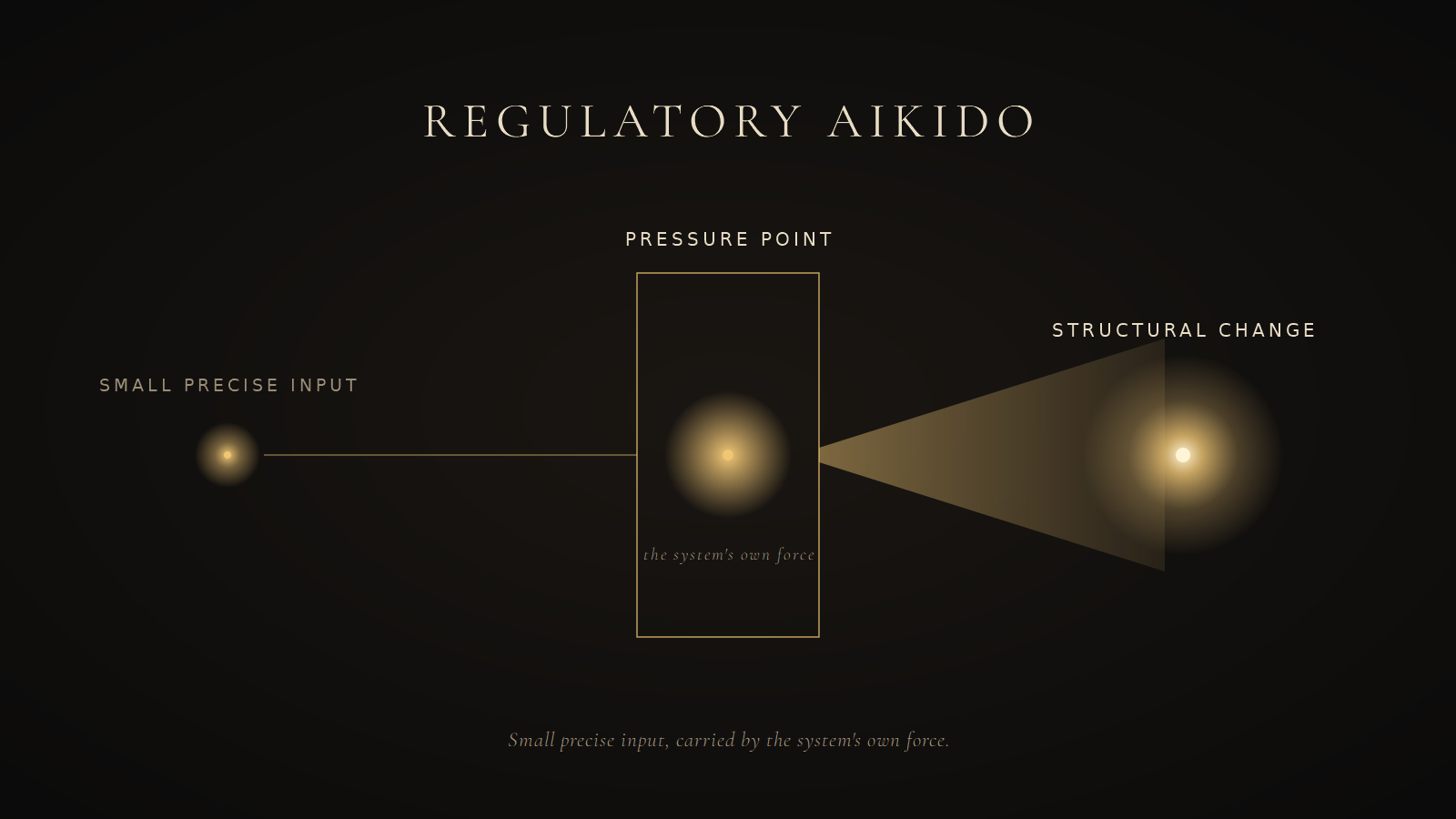
A system designed to absorb opposition will absorb opposition. The structural move is not to push harder but to find the pressure point where small precise intervention produces change the system's own momentum carries forward.
Most attempts to change a regulatory, institutional, or social system push directly against its force. The system is designed for this kind of pressure; absorbing it is what the system does. Force met with force tests which side has more force; the result is exhaustion on both sides, with the underlying structure largely intact.
Regulatory aikido is the practice of locating where the system's own force can become the medium of structural change. Two metaphors carry the form — one from martial practice, one from medicine — and the framework reads them as the same structural move at different scales.
Bring a system you are currently inside or pressing against to mind. Notice whether what you have been doing is force-against-force, or whether you have located the pressure point where the system's own momentum could carry the change you are seeking.
Two metaphors, one move
Same structural move: small precise intervention at a leverage point, using the system's own force as the medium. The framework treats this as a practice of system-engagement that scales from intimate relational dynamics through institutional change.
The four moves
Move 1Read the system's force structure
Before any intervention, name what pressure exists in the system, where it routes, what it is designed to absorb, what it is structurally vulnerable to. The system's own documentation, mandates, stated commitments, and internal contradictions are the map. Most practitioners attempt change without reading first; the reading is the larger portion of the work.
Move 2Locate the pressure point
Find the specific structural location where a small precise intervention produces disproportionate change. The pressure point is rarely the symptom; it is the structural element that the symptom is downstream of. Pressure points are often boring, technical, and out of public view — which is why they are pressure points.
Move 3Compose the intervention
Make the intervention small, precise, and structurally legible to the system as something the system already has to respond to. The intervention uses the system's own channels — its review processes, its stated values, its existing procedures — as the medium. An intervention that requires the system to recognize a new category to respond to it has not yet been composed correctly.
Move 4Release the intervention
Once composed, release the intervention and let the system metabolize it. No follow-up campaign. No public pressure. No coalition. The intervention is structural; the system's own momentum carries the change. Practitioners who cannot release the intervention often convert the work back into force-against-force, which the system then absorbs.
Why it works when force does not
A system's defensive structure is built against the kinds of pressure it expects. Direct opposition, public campaign, mass mobilization, legal challenge — all of these are pressures the mature system has architectures to absorb, deflect, or convert into legitimacy for its existing form.
A precise intervention at a structural pressure point uses the system's own logic against the system's current shape, often by holding the system to its own stated commitments more rigorously than the system is comfortable with. The system cannot refuse the intervention without refusing its own legitimacy. The change happens because the system's defenses route the practitioner's small input through the system's largest channels.
This is not a trick. It is a structural read of how mature systems operate, and a practice of working with that structure rather than against it.
The pattern across substrates
The same structural move, with the medium changing per substrate:
- Biological
- Small somatic interventions that let the body's own regulation system do the larger work — a breath pattern at the moment of dysregulation, a specific touch that reorganizes the nervous system's response. Not pushing the body to comply; using the body's own regulatory architecture as the medium.
- Institutional
- Holding an institution to its own stated commitments at a specific structural point — a single procedural correction, a named contradiction between policy and practice, a request the institution's own procedures require it to process. The institution metabolizes; the change propagates through its own channels.
- Relational
- A precisely stated sentence that names a pattern the other person's own framework requires them to address. Not argument, not appeal — the structural mirror that lets the relationship's own logic carry the change. The shadow is manipulation; the difference is whether the practitioner is using the other's own ground in service of the relationship or in service of getting something.
- Technical
- A patch at the specific architectural location where the bug actually lives, rather than at the symptom site. A schema change that makes the unwanted state unrepresentable. An API contract that holds upstream and downstream systems to consistent behavior the existing complexity could not enforce.
See The Four Substrates for the broader cross-substrate read.
Failure modes
The practice has specific failure modes the framework names structurally.
Wrong pressure point. The intervention is at a structural location adjacent to the actual leverage point. The system absorbs without change. Diagnostic: did the intervention produce a response proportionate to its precision? If not, the read of the force structure was off.
Force creep. The practitioner cannot release the intervention; they keep adding pressure to ensure the change occurs. The work converts from aikido to force-against-force. Diagnostic: the practitioner's body registers the moment the work crossed back — usually as fatigue or escalating righteousness.
Manipulation drift. The same structural move, used in service of the practitioner rather than the system's coherence, becomes manipulation. The diagnostic is whose ground the work is operating from: working with the system's own logic in service of structural integrity is aikido; using the system's logic to extract from it is manipulation. The body knows the difference.
Coalition collapse. The practitioner converts the small precise intervention into a public campaign requiring coalition support. The system now has surface to push back against; the leverage is lost. Diagnostic: was the move composed to require coalition, or was the coalition added because the practitioner was uncertain whether the move would carry?
Why this matters operationally
Single-practitioner change work in regulatory and institutional systems is structurally possible without coalition, mass mobilization, or coercive force. Most attempts that fail do so because the practitioner read the system as requiring force-against-force, when the system's own architecture provided a leverage point the practitioner had not yet found.
The practice is not a substitute for collective action where collective action is what the structural moment calls for. It is the specific practice for the structural moments where one practitioner with a precise read can produce change the system's own momentum will carry. Distinguishing those moments from the moments that require collective force is itself part of the practice.
Where this pattern shows up in the practice
- Refusal As A Generative Act
- Refusal in regulatory aikido form: the named limit at the structural pressure point that the system's own logic must respond to.
- A Theory of Gift
- The gift form operating at institutional scale is one specific application of regulatory aikido — the system absorbs the gift, then has to metabolize what the gift entailed.
- The Meta-Tetrahedron
- The framework's geometric form as itself a regulatory aikido move — a structural read of how systems hold and where they leverage.
- Architecture of Coherence — Complete Suite
- The manuscript treats system-engagement at multiple scales; the regulatory-aikido practice is the operational layer beneath several of its case studies.
- Lineage
- The practice traditions this synthesis draws on — martial, medical, institutional, somatic.
Lineage
This synthesis rests on the aikido tradition (Morihei Ueshiba's foundational practice of force redirection); on Traditional Chinese Medicine's acupuncture practice (small precise needles at structural points in the meridian system); on Donella Meadows's work on leverage points in systems (the structural locations where small input produces large change); on James C. Scott's Weapons of the Weak (the practices of structural change available to those without institutional power); and on the broader traditions — somatic, martial, ecological, institutional — that treat working-with-force as more skilled than working-against-it. Specific attributions in the Lineage entry.