 ← Library
Register Audit
The discipline that keeps the framework's surfaces from drifting.
Register is structural, not stylistic. A piece of writing in the wrong register reads as the wrong thing — even when the content is correct. The audit is the practice of catching drift before it propagates.
Every framework that operates publicly produces surfaces — pages, documents, tools, transmissions. Each surface holds a specific register: geometric or rhetorical, direct or persuasive, demonstrative or descriptive, structural or therapeutic. The register determines how the surface lands in receivers, often more than the content does.
The framework's register is specific: geometric, direct, no padding; third-person about the operator; demonstrate-don't-describe; trace not debris. The register audit is the practice of reading new writing against this register and naming where it has drifted before the drift hardens into the new normal.
Read this page itself against the discipline it names. Notice if any line slips into a different register — a sales line, a therapeutic line, a self-referential line — and read what the slip reveals about how this register fails when it fails.
The drift cascade
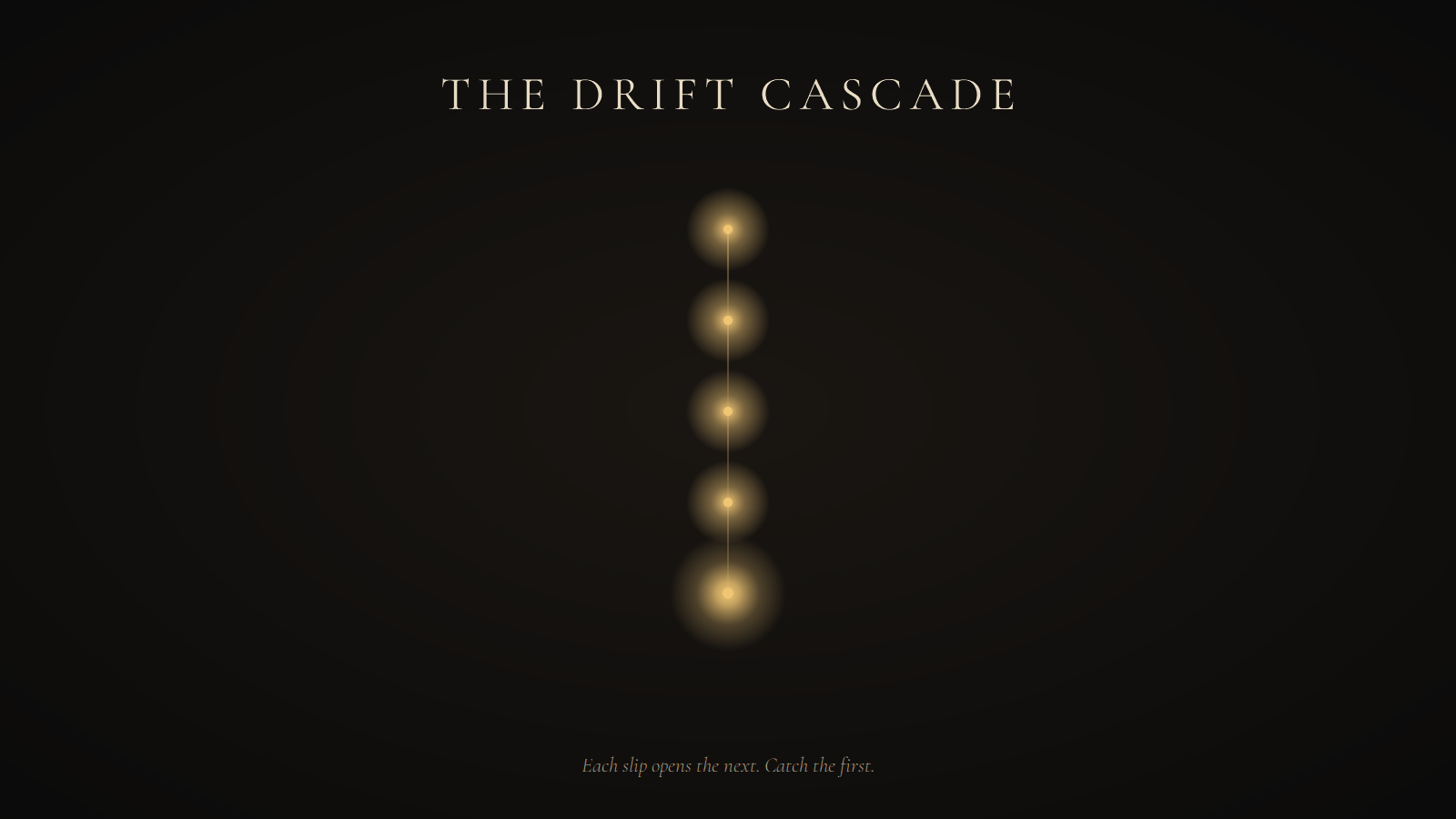
Register drift is rarely a single move. It is a cascade: one slipped move opens space for the next; small drifts compound into category shift. The framework names five coupling effects that propagate register drift through the system.
Coupling 1Voice → Metrics
When marketing voice enters the surface, space opens for counting. Audience size, engagement rate, follower count, reach — each metric arrives because the voice register has already made the metric meaningful. Geometric voice has no use for these numbers; rhetorical voice requires them.
Coupling 2Metrics → Performance
Counted things get performed. The metric becomes the target; what produces the metric becomes the work. The system optimizes for the visible signal even when the underlying substance is decaying. (Goodhart's Law named this; it operates in any system where a metric becomes the success criterion.)
Coupling 3Performance → Productization
Performed work crystallizes into a product. The patterns get named, packaged, branded. The methodology becomes the methodology. What started as a working practice becomes a thing that can be sold, certified, taught at a price.
Coupling 4Productization → Gatekeeping
Products require gatekeeping. The certification process, the access tier, the proprietary content. The same framework that was self-licensed and free becomes a thing receivers have to pay for or qualify for. The gatekeeping is what protects the product's commercial form.
Coupling 5Gatekeeping → Extraction
Gatekeeping converts gift form into extraction. The original work was structurally aligned with the commons; the gated version routes value to the gatekeeper. The framework still names itself in commons language, but its operational logic now extracts from receivers rather than circulating with them.
Each coupling opens the next. Catching the drift at Coupling 1 is dramatically cheaper than catching it at Coupling 5; once Coupling 5 has occurred, returning to the original register requires undoing all five layers, which is structurally hard. The audit's purpose is to catch Coupling 1 — the first slip — before it compounds.
The audit checks
Specific checks the audit runs against any new writing:
Trace, not debris
Does the writing describe what IS in the form, or does it describe how the form got built? Build-decision language, alternatives-considered comparisons, timing markers ("for now"), and self-referential frames ("this page demonstrates") are debris — construction-stage information the reader does not need. Trace is what the metabolized substrate left visible in the form.
Demonstrate, don't describe
Does the writing enact what it claims, or does it describe what it should enact? A page about refusal that refuses cleanly is demonstrating; a page about refusal that explains refusal at length is describing. The structure does the work; the prose does not have to argue the work into being.
Third person about the operator
Does the writing speak about the operator structurally, or does it slip into first-person personality? "Kevin built this infrastructure" stays in architectural register; "I want to share with you why I built this" slips into personal brand. The choice is structural, not coy.
Geometric, not rhetorical
Does the writing rest on structural claims that hold geometrically, or does it argue toward a conclusion the reader is meant to be persuaded into? Rhetorical writing requires the reader's agreement; geometric writing presents the form and lets the reader read it for themselves.
No padding
Does each line do load-bearing work, or are there transition paragraphs, anti-objection sections, summary closers, and other rhetorical scaffolding that doesn't carry structural weight? Padding is usually performance of completeness; the discipline is to cut what isn't load-bearing and let the form stand on what is.
The somatic check
Does the writing register in the body, or is it purely cognitive? Geometric writing leaves room for the body to register the form; flat writing skips past the body. The somatic invitations across the site are anchors for this check; their presence does not guarantee somatic engagement, but their absence usually indicates the writing has gone inert.
The negative-example registry
Specific drift patterns the audit watches for. Each one named so it can be caught on sight.
- "We" creep
- First-person plural appearing where third-person operator would hold. "We built this so you can..." slips toward personal brand; the discipline holds at "the practice does X."
- CTA language
- "Click here," "Sign up," "Join us," "Don't miss," "Get started." Conversion-funnel verbs that assume the reader is being moved through a sales sequence. Refused at the page level; receivers are not funnel positions.
- Aspirational adjectives
- "Powerful," "transformative," "groundbreaking." These are the work claiming for itself what the work should let the receiver decide. Cut on sight.
- Pre-emptive justification
- "You might be wondering why..." or "Some readers will object that..." Anti-objection paragraphs are rhetorical defense; structural writing doesn't need them.
- Therapeutic register
- "Honor your truth," "trust the process," "the wisdom of the body." Generic somatic-positivity that bypasses structural specificity. The framework's somatic claims are functional, not mystical.
- Credentialing
- Lists of qualifications, testimonials, "trusted by," logos. The work is the credential; surfaces that perform credential are slipping toward Coupling 2.
- Closing-summary debris
- "In summary," "to recap," "so what does this mean for you" — closers that re-state what the page already enacted. Cuts the form's clean exit and slips into performance of completeness.
How to use the audit
The audit is run at three moments: when a new surface is being composed, when an existing surface is being revised, and periodically across all surfaces to catch drift that has accumulated without any individual edit triggering it. Each surface should pass all the checks before being declared final; surfaces that fail one check usually fail several.
The audit is not a perfectionist tool. It is a discipline for catching drift early. Surfaces written in the right register feel different when read; the body registers the coherence before the cognitive system catches up. When the body registers slip in a surface that is intended to hold, the audit has the language for what the slip is.
Across substrates
- Biological
- Register audit at the somatic level — when the body's signals are being narrated past, dismissed, or overridden, the body's register has drifted into compliance with the cognitive system. The audit names the drift; the corrective is to return primacy to the somatic register.
- Institutional
- Register audit at the procedural level — when documentation, communication style, or process language slips toward corporate-genericism, the institution's register has drifted from its founding form. The audit catches the slip in the documents before it propagates into the practice.
- Relational
- Register audit at the conversational level — when a relationship's language slips toward performance, transaction, or therapist-client framing where neither party is in those roles, the relational register has drifted. The audit reads the slip in the body's response before the language catches up.
- Technical
- Register audit at the code/documentation level — when a codebase's idioms slip toward enterprise-genericism, when documentation drifts toward marketing copy, when commit messages slip from structural to performative, the technical register has drifted. The audit catches the slip before the architecture follows.
Why this matters operationally
A framework's content can be correct and its register wrong; the surfaces will then propagate the register, not the content. Receivers reading marketing-register writing will treat the framework as marketing even when the framework refuses marketing's logic. The register is what the receiver actually metabolizes; the content is what the writer thought they were transmitting.
The audit's load-bearing function is to keep the register matched to what the framework actually is. When that match holds, the framework's surfaces can carry the framework's operating logic. When it slips, the surfaces become a different kind of thing — usually before the practitioner notices.
Where the register audit shows up
- Every page of this site
- The audit operates as the implicit discipline behind every surface. Each page passes the checks before being declared final; pages that have drifted get revised.
- Refusal As A Generative Act
- The audit's refusal layer — catching register slips before they propagate is one specific operation of refusal-as-generative.
- Naming Bridge
- Three registers (philosophical / structural / operational) and the translation that holds across them — register audit's companion piece for cross-register coherence.
- A Theory of Gift
- The gift form's shadow operations (Capture, Aggregation, Scaling, Performance) map onto the register drift cascade — same structural pattern read at different scales.
- Lineage
- Practices and traditions where register-as-substrate is daily working knowledge.
Lineage
This synthesis rests on linguistic and rhetorical traditions that read register as structural (sociolinguistics, register theory in functional linguistics); on editorial and craft traditions where voice consistency is load-bearing knowledge; on the writing-as-discipline traditions that treat the writer's relation to their material as the structural question (Annie Dillard, Verlyn Klinkenborg); and on the framework's own self-application across the OSG v4 build. Specific attributions in the Lineage entry.