 ← Library
Naming Bridge
The same idea, at three resolutions, with the translation that holds across them.
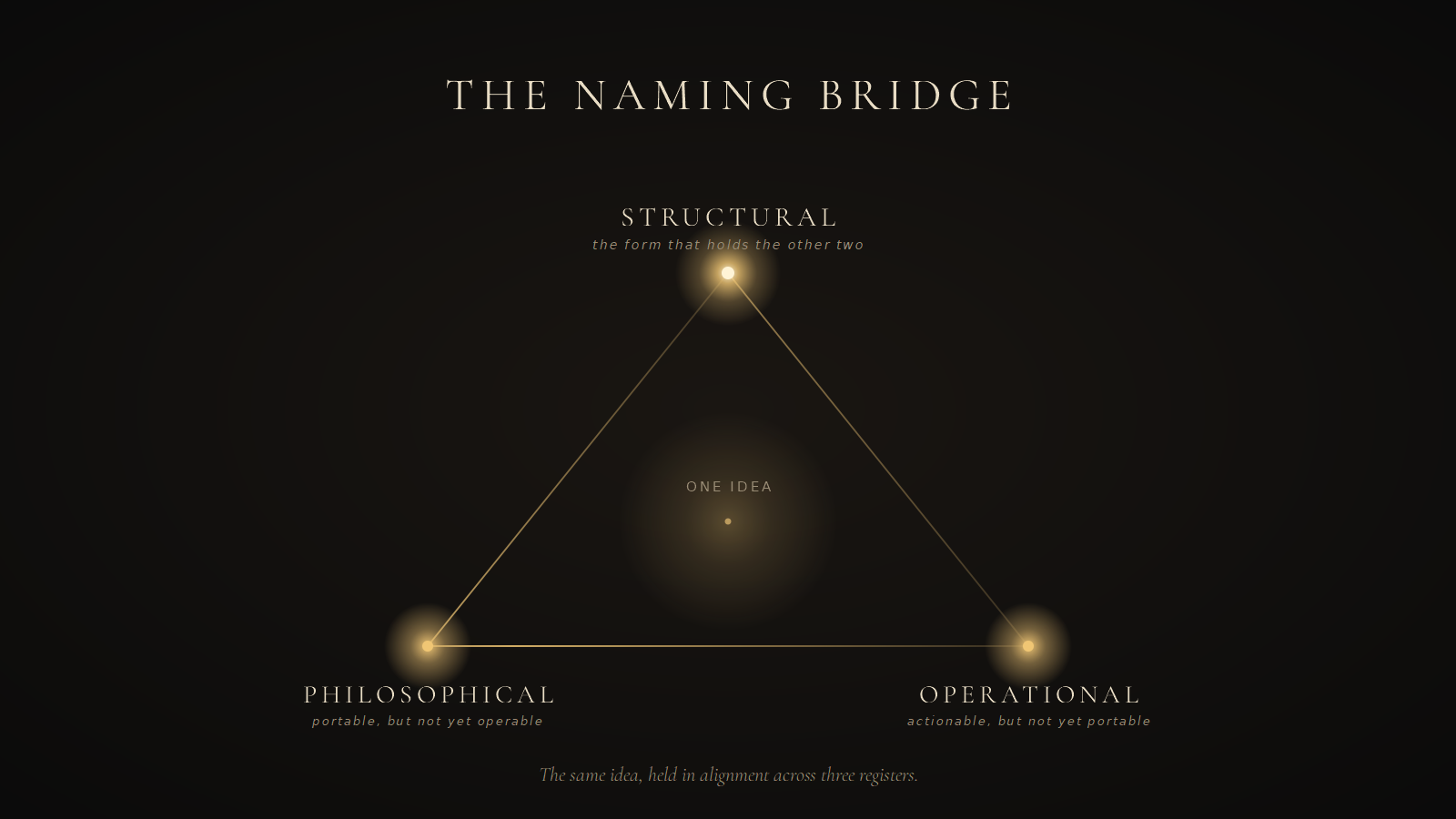
An idea that can only be named philosophically is not yet grounded. An idea that can only be named structurally is not yet operational. An idea that can only be named operationally has lost the form that lets it propagate. The naming bridge is what holds the three registers in alignment.
Frameworks fail at the register they cannot bridge. Philosophical frameworks that never reach operational form remain conceptual; operational frameworks that lack philosophical or structural grounding cannot scale or propagate; structural frameworks that never operationalize stay as diagrams. The naming bridge is the practice of always being able to translate the same idea across all three registers, and reading the slip when one register is missing.
Bring one idea you work with regularly to mind. Try naming it at all three registers — philosophical, structural, operational. Notice which translation comes easily and which strains. The strain names which register your work has not yet metabolized.
The three registers
Philosophical
The idea in its most general form. The conceptual register; the claim before the structure; the principle without its geometry.
What philosophical naming gives: portability across contexts, recognizability across disciplines, the kind of generality that lets the idea travel. What it does not give: operability, specificity, a way to act on the idea in any particular case.
Structural
The form / geometry / architecture of the idea. The way the idea is shaped; the units it operates in; the relations between those units.
What structural naming gives: a model that can be examined, tested, compared with other models. The idea becomes diagrammable. What it does not give: traction in any specific situation; the structure can be correct and still inert.
Operational
The idea in working practice. What it does; how it shows up; the specific moves a practitioner makes when the idea is operating.
What operational naming gives: actionable specificity; the test of whether the idea actually does anything. What it does not give: the generality that lets the idea travel to other practitioners; the structural form that lets it scale.
The bridge in action
The same framework concept named at all three registers. Each row is one concept; each column is one register. The naming bridge is what makes the three columns recognizable as the same thing.
| Concept | Philosophical | Structural | Operational |
|---|---|---|---|
| Recognition | The moment when work is picked up by another and operated with on their own ground. | The fifth of five frames (Terrain · Apparatus · Form · Recognition · Propagation), distinguished from validation by its forward motion. | The Transmission Engine's asset emissions; the kit being run on someone else's system; receivers building their own version of the framework. |
| Gift | The form that circulates between distinct beings without converting their relation into ledger. | One of six axes of the gift form (Differentiation ↔ Architecture); substrate deposited into things that persist without the giver. | The offerings page's six gift cards; the self-licensed framework substrate; the donation rail's refusal of acknowledgment ledger. |
| Consent | The moment-by-moment agreement that determines whether the same action lands as gift or as extraction. | The four positions of the Wheel of Consent (Serving · Allowing · Taking · Accepting) and their shadow forms. | The quadrant labels on each offering card; the commons-work consent at consultation intake; the pre-audit gate in the kit. |
| Boundaries | Limits stated as information rather than as enforcement. | The Boundaries vertex; refusal as a generative act with shadow forms (rule, performance, gatekeeping, self-righteousness). | The four anti-extraction axes; the capacity ceiling on consultations; the Wed/Thu calendar boundary; the donor discipline statement. |
| Substrate | The metabolized ground that any specific form rests on. | Four substrates (Biological · Institutional · Relational · Technical); each with characteristic medium for the gift form's six axes. | The comparison matrix; the kit's substrate-selection flow; the per-substrate prescriptions. |
| Refusal | The structural act of naming what will not occur, so what occurs can hold cleanly. | Four vertex-refusals (one per vertex) and four shadow forms when refusal drifts. | The Refusals page; every "what is NOT offered" section; the no-Stripe-on-Cal.com move; the donor discipline. |
Each row reads as the same idea once the bridge is held. A reader can enter at any column and reach the others. The translation is the bridge; the bridge is what the framework's coherence rests on.
The bridge check
Specific checks the naming bridge runs against any framework move or claim.
Can it be stated philosophically?
If the claim cannot be named at the conceptual level — if it requires reference to specific operational details to make sense — the claim has not yet abstracted to portable form. It will not travel to other practitioners or other domains.
Can it be diagrammed structurally?
If the claim cannot be shown as a geometric form — vertices, edges, relations — the claim has not yet found its structure. It will be hard to compare with other framework moves, hard to test for coherence, hard to teach beyond the originator.
Can it be operationalized?
If the claim cannot be pointed to as something the practice actually does, in a specific working surface, the claim has not yet landed in working form. It remains theory that will not be picked up by other practitioners as functional substrate.
Do the three name the same thing?
The bridging is what holds the three together. If the philosophical claim and the operational practice point at different things, the bridge has slipped — usually meaning the structural register is missing or has drifted, since structure is what holds the other two in alignment.
Why three registers, not two or four
Two registers (e.g., theory and practice) collapse the structural layer. Without structure, theory and practice become opposed rather than translatable — practitioners read theory as remote and theorists read practice as ungrounded; the bridge becomes a chasm. Adding the structural register is what lets the bridge be built; structure is what theory and practice both rest on.
Four or more registers risk overspecification. The three the framework names are the minimum set that holds the bridge under operating conditions; adding more tends to fragment without adding load-bearing distinction.
Across substrates
The three registers operate in each substrate with characteristic media:
| Substrate | Philosophical | Structural | Operational |
|---|---|---|---|
| Biological | Felt sense, somatic knowing, the body's prior recognition. | Polyvagal architecture, nervous-system maps, regulatory geometry. | The breath pattern, the somatic practice, the specific intervention. |
| Institutional | The institution's mission, principles, stated values. | Org charts, decision-rights maps, governance documents. | What actually gets decided, by whom, with what consequence. |
| Relational | The values the relationship operates under, the kind of bond it is. | Wheel of Consent quadrants, patterns of mutual responsibility. | The specific words said, the specific moves made, the body's response. |
| Technical | The principle the system is meant to enforce. | The schema, the contract, the architecture diagram. | The running code, the actual behavior under load, the bug. |
See The Four Substrates for the broader cross-substrate read.
Why this matters operationally
A practitioner whose work lives in only one register cannot teach it, propagate it, or stress-test it. The bridge is what makes work portable, examinable, and operational simultaneously. The framework's commitment to maintaining the bridge at every concept is what makes its surfaces internally coherent — and what makes the gap visible when a concept is failing to bridge.
Where this page would itself fail the bridge: if its claims about the bridge could not be operationalized in some specific check, or if its operational examples did not point back at the philosophical claim. The page passes its own bridge by holding all three.
Where the naming bridge shows up
- Register Audit
- Companion piece: register audit catches register slip; naming bridge catches register absence. Together they hold the framework's surfaces.
- The Meta-Tetrahedron
- The document walks the framework at the structural register while pointing toward operational and philosophical correspondences across its eight parts.
- The Four Substrates
- Each substrate carries the registers differently; the comparison matrix is itself one instance of the bridge held across substrates.
- A Theory of Gift
- Walks the gift form at all three registers across its six axes.
- RI Kit
- The kit is the operational register of the framework's diagnostic; the manuscript holds its philosophical and structural correspondences.
Lineage
This synthesis rests on the broader traditions where theory-and-practice bridging is treated as the load-bearing question (practical philosophy, action research, the pragmatist tradition); on the cybernetic insistence that structure mediates between abstraction and operation (Bateson, Beer); on the embodied-learning traditions that read across registers as natural movement rather than translation; and on the framework's own self-application across the OSG v4 build. Specific attributions in the Lineage entry.