 ← Library
Glossary
Vocabulary the framework uses with precision.
When a framework's words mean what common usage means, the framework is not yet structurally specific. When they mean something different, the difference is load-bearing — the structural distinction the term carries is the framework move the term names.
This page lists the vocabulary that does work in the framework, grouped by structural relation rather than alphabetized. Each entry names the term and gives the precise meaning; where the framework's use diverges from common usage, the divergence is stated explicitly.
The glossary is reference, not synthesis. Read it as needed; the deeper treatments live on the linked Library pages.
Geometric vocabulary
- Apparatus
- The substrate-producing infrastructure built on a practitioner's specific terrain. Stays where it was built; does not travel. Distinct from the form, which is what the apparatus emits.
- Center
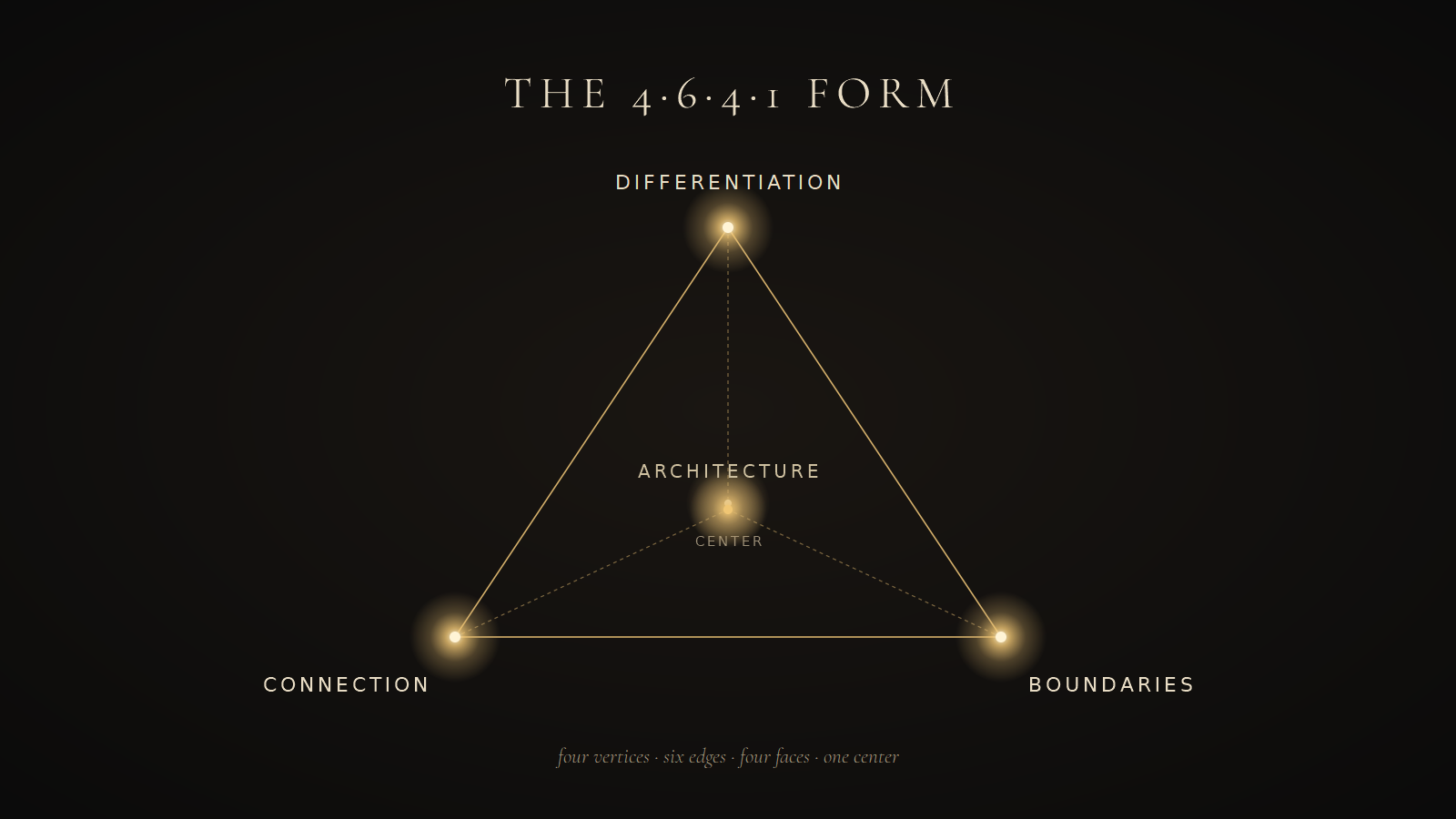
- The somatic ground at the middle of the 4·6·4·1 form. One literal ground shared across scales; not portable; each practitioner's own.
- Edge
- One of the six pair-interactions between vertices. Each edge names an integration the form must hold.
- Face
- One of the four failure modes of the form. Each face names what fails when its corresponding vertex drops.
- 4·6·4·1 form
- The framework's geometry: four vertices, six edges, four faces, one center. Walked at multiple scales by the Meta-Tetrahedron.
- Form
- The portable structural shape. Travels across practitioners; can be picked up on new ground. Distinct from apparatus (which stays).
- Ground
- What each practitioner's form rests on. Specific, embodied, non-portable. Same form, different ground.
- Substrate
- The metabolized ground that any specific form rests on. The body of work — embodied, written, built — that the practice has assimilated.
- Vertex
- One of the four functional capacities the form must hold. Geometric, not metaphorical; each vertex is structurally specific.
The four vertices
- Architecture
- The capacity for what persists without the maker. What outlasts daily expenditure; what survives leadership transition; what holds in the absence.Common usage: buildings, design. Framework usage: structural persistence as a functional capacity.
- Boundaries
- The capacity for limits stated as information. Edges that hold without continuous enforcement.Common usage: rules, walls, prohibitions. Framework usage: structural articulation of what is and isn't, as information that protects both sides.
- Connection
- The capacity for genuine exchange between distinct beings — contact that actually arrives, produces change, loops back.Common usage: social link, network. Framework usage: substantive exchange that changes the participants.
- Differentiation
- The capacity to know what one is and what one is not. Position that holds; distinctness from environment; specific contribution.Common usage: distinguishing. Framework usage: the structural capacity to remain a discernible thing.
The six edges
- Circulation
- Connection ↔ Architecture. Tools and artifacts moving through where receivers arrive. The propagation axis.
- Consent
- Connection ↔ Boundaries. The structural agreement between contact and limit; the position determines whether action lands as gift or extraction.
- Deployment
- Boundaries ↔ Architecture. Tools made operational with built-in limits. The infrastructure-with-edges axis.
- Gift
- Differentiation ↔ Architecture. Substrate deposited into things that persist without the giver. The form that circulates without converting to ledger.
- Relationship
- Differentiation ↔ Connection. How distinct beings come into actual contact while remaining distinct.
- Self-Knowledge
- Differentiation ↔ Boundaries. What is known about the practice becomes how its limits operate.
The four faces
- Dissolved
- Differentiation missing. Position cannot hold; trust cannot form; the system has no shape.
- Ephemeral
- Architecture missing. Nothing persists; the system operates only as long as someone is actively holding it.
- Isolated
- Connection missing. Distinct elements exist but do not actually exchange; the form of contact preserved while substance has gone.The bound, stated as information: where coordination succeeds through anonymity (markets) or generative division (healthy forks), this face misreads a success as a failure. The error there is the framework's, not the domain's.
- Overflowing
- Boundaries missing. Limits are not visible; capacity disappears into whatever shows up.
- Shadow form
- The failure-mode operation of a structural position when its consent is missing or when one vertex has dropped. Each face, each position on the Wheel of Consent, each axis of the gift form has a shadow.
Practice concepts
- Capacity
- Operating throughput. Body-discriminated, not slot-counted. When the body says capacity is reached, intake closes — regardless of available calendar.Common usage: maximum possible load. Framework usage: actual operating throughput as the body discriminates it.
- Correspondence class
- The honesty grade on any cross-domain mapping: structural (insight flows both ways) · bounded (the object-layer mapping is real, but the load-bearing formal claim returned bounded under verification) · illustrative (insight flows one way) · contested (rests on disputed science, held with its caveat sharp). A correspondence is never upgraded to pad the ledger.
- Debris
- Construction-stage information embedded in writing — build decisions, alternatives considered, timing markers, self-referential framing. What the reader doesn't need; rafters of the build.
- Demonstrate (vs describe)
- The structural discipline: enact what the page claims rather than describe what it should enact. The structure does the work; the prose does not have to argue.
- Felt safety
- The regulated-nervous-system ground that coordination runs on. The substrate, not a byproduct: structure imposed on an unready substrate manufactures proxies for trust, not trust. Readiness — the first threshold precondition — is this, named at system scale.
- Personal scale
- The correct unit for this practice. Not a downgrade from scalable; the structurally appropriate scale for the work.Common usage: smaller than corporate. Framework usage: the unit where the form actually holds, refused as preliminary to anything larger.
- Recognition
- The crossing of the threshold where another practitioner picks up the form on their own ground and operates with it. Opens a use.Common usage: acknowledgment. Framework usage: structural pickup; distinct from validation.
- Refusal
- The structural act of naming what will not occur so what occurs can hold cleanly. Generative, not negation.
- Register
- Voice, positioning, structural style of writing or practice. Geometric vs rhetorical, demonstrative vs descriptive, structural vs therapeutic.
- Self-license
- "Use freely. Adapt as needed." The framework's distribution stance: propagation by utility rather than control, no attribution required — the gift carries no return address.
- Somatic ground
- The body's threshold for the practice. What the body either crosses or doesn't; not yielding to argument.
- Threshold
- The structural moment of phase transition. Requires four preconditions simultaneously: Readiness, Precision, Novelty, Bidirectionality.
- Trace
- What the metabolized substrate left visible in the form. The reader experiences trace as how the site IS. Distinct from debris.
- Validation
- Receiver-agreement that closes a transaction. Returns to the maker as confirmation. Distinct from recognition.Common usage: confirming correctness. Framework usage: structural closure; the work stays where it was made.
Practice mechanics
- Asymmetry
- Structural separation between channels — donation rail and engagement rail, operator view and receiver view. Sealed from each other by design.
- Commons-work consent
- The consultation tier's default arrangement: patterns from the engagement may appear, generalized and anonymized, in published substrate. Receivers consent before engaging.
- Drift cascade
- The five-coupling chain by which register drift propagates: Voice → Metrics → Performance → Productization → Gatekeeping → Extraction.
- Engagement form
- The consultation tier's two event types: 30-minute initial consultation and 1-hour follow-up session. Engagement is emergent — follow-ups happen if the work wants them; written substrate-readings fold into the same flow through the initial intake.
- Fit filter
- The five-question routing tool between Public Face and the consultation calendar. Outcomes: Fit / Substrate first / Outside the tier.
- Friction cost
- The structural property of a form that determines whether receivers pick it up. Lowering friction cost is the maker's responsibility, not the receiver's burden.
- Pre-audit gate
- The three statements that must be true before the kit operates: specific system in mind, system has begun to feel incoherent, responsible for or inside the system.
- Substrate audit
- The second diagnostic layer, run alongside the structural one: is coordination grounded in felt safety, or in structural proxies (metrics, rules, reputation scores)? A system can hold all four vertices on paper and still be hollow, because the architecture was imposed to manufacture trust rather than deposited from it. Only this layer predicts that fragility in advance. The opening question: which came first here — the trust, or the trust metrics?
- Substrate-bearing instance
- A working example the framework was extracted from rather than derived to fit. Distinct from a test case or illustration.
- Wheel of Consent quadrant
- One of the four positions consent can hold: Serving · Allowing · Taking · Accepting. Determined by who is doing and for whose benefit.
How to use the glossary
The glossary is reference, not introduction. New readers will find the framework's vocabulary easier to encounter through the deeper texts (Meta-Tetrahedron, Theory of Gift, Architecture of Coherence) than through definitional entries.
Returning readers can use the glossary to verify precision — when a term reads as familiar, confirm whether the framework's use is what common usage would assume, or whether the divergence-line under the term names a structural distinction worth holding.
The glossary is additive. New terms get added when the framework crystallizes new vocabulary; terms that fall out of use get retired. The page reflects the framework's current operating vocabulary, not a complete catalog of every term ever used.
Where the vocabulary is operating
- The Meta-Tetrahedron
- The full geometric form using the vocabulary in operating context. The canonical reference for vertex, edge, face, center, form, ground.
- Architecture of Coherence — Complete Suite
- The synthesis manuscript expands the vocabulary across the framework's full scope.
- Naming Bridge
- How the same term is held across three registers (philosophical · structural · operational) without losing precision.
- Register Audit
- The discipline that catches when vocabulary slips from precise framework use into common usage drift.
- Library
- The full set of texts where each term is treated at depth.